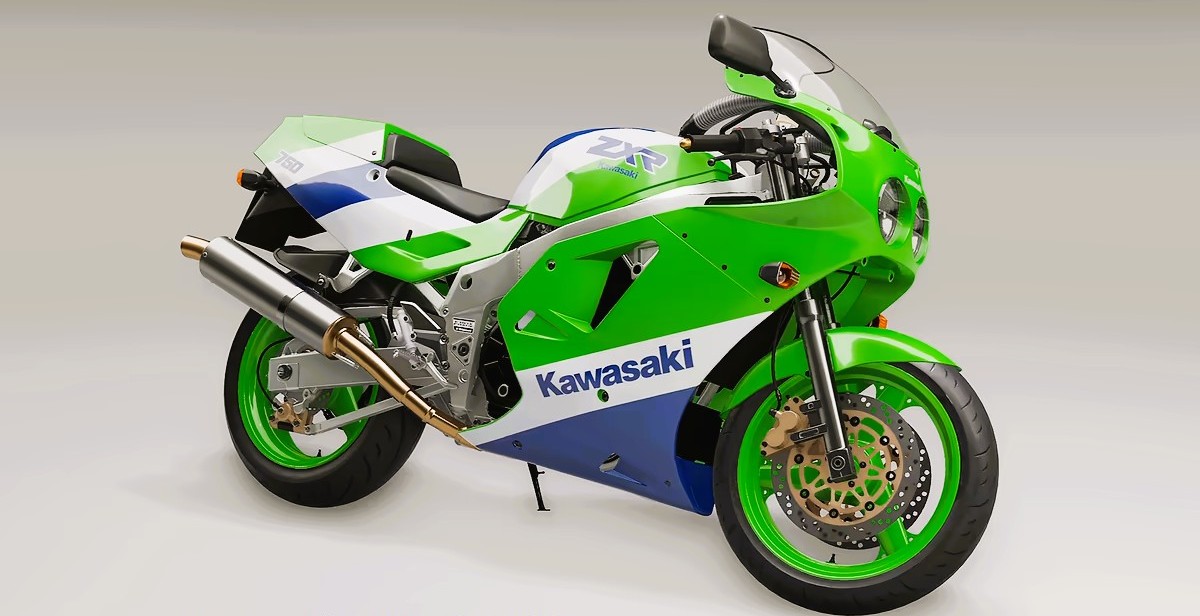
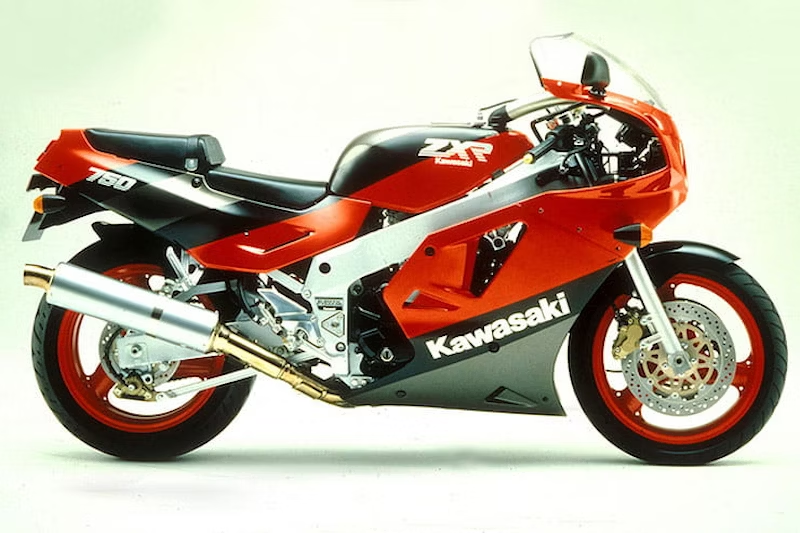
1989 Kawasaki ZXR750 H1
It’s 1968. In Vietnam, bits of young Marine are being blown around the US embassy compound while the Tet offensive rages. Back in the USA, the undrafted mates are buying big motorcycles in unheard of volumes — Norton Commandos, BSA Spitfires, Harley Sportsters, Triumph Bonnevilles. They want horsepower, more and more exhilarating horsepower. Throttle thrills to be enjoyed before the ticket to the Magical Mystery Tour takes them away …
Over at Kawasaki Heavy Industries in Japan, a young suspension and frame engineer ponders a memo from his marketing superiors.
“Dear Ichiko,
You have been told the boys from the motor department have come up with a 500cc two stroke triple designed to do three things.
Let us refresh you.
1. It must destroy round eye four stroke twins between stoplights.
2. It must pull giant wheelies.
3. It must be on the streets before Soichiro’s boys run out that four cylinder monster they think is a big secret.
Dyno tests reveal that above 6,000 rpm Project H1 will fulfil design criteria 1 and 2.
You are the problem with criteria 3. You have a career decision, Ichiko. Either slide rule us a rolling chassis with a light front end within two weeks or find another career. We hear Sony is recruiting solder gun operators. Ever seen what solder fumes do to brain cells? Think about it, but not for long.”
Ichiko didn’t. In eight days flat he designed one of the most evil handling motorcycle chassis the world has ever fallen off: the Kawasaki Mach III H1. But he didn’t enjoy it, and he knew that one day there would have to be An Atonement…
It is now 1989. In China, bits of young student are being blown around Tiananmen Square as the PLA goes berserk. But at Kawasaki Heavy Industries a middle aged but still passionate suspension and frame engineer has made his Atonement for a long ago mistake. It is called the ZXR750 H1.
It has been a long time since Kawasaki created a stunning 750. The last one I remember was the Uni-Trak GPz750, a sweet-handling 18-inch wheeler with an adrenalin-inducing top end. The Turbo was pretty flash, too. Then came the boring GPz750R and the too-late-mate GPX750. Meanwhile Honda, Yamaha and Suzuki have been cleaning up the 750 sports market with their VF, FZ, and GSX -R bikes.
The ZXR750 may be the last weapon into the repli-racer fray, but it is a stunner. This time race track chassis development has translated to the business on the road. And the ZXR is not fussy which road. From baby-bum smooth sweeper to the gnarliest, truck-destroyed, 45 km/h decreasing radius nightmare, the ZXR chassis allows its pilot to link rubber to tarmac without drama. The lime green machine handles safely, securely, brilliantly.


It makes a joke of slices of road where merely good handling bikes start to feel overwhelmed. Eight months of rain and semis have made a mess of the famous Bulahdelah bends on the Pacific Highway south of Nabiac. It’s so bad the tar brushers have dropped the limit to 80 km/h. Nailing the ZXR through that array of bumps, gravel and potholes produced nought in the way of twitches, weaves or bump steer.
In several thousand klicks of testing over NSW’s rain-dissolved roads I received a total of one big kick from the bars hitting a giant road zit one-handed on a trailing throttle at 100 km/h. A stupid and potentially deadly mistake. The ZXR’s front wheel jarred right once then returned to track as if nothing had happened. Thanks very much Ichiko.

Roadholding is phenomenal, which is not surprising given the amount of rubber on the road. Up front is a 120/70 Bridgestone Cyrox radial on an MT 3.5 x 17 inch rim while the rear travels on a massive 170/60 spread across an MT 5.5 rim. The rear tyre would give good service on a Massey Fergusson. Potential owners should stock up on boots and maybe a G-suit – this motorcycle can change attitude fast enough to pull noticeable Gs.
Cornering clearance is a non-issue. I wore out a pair of perfectly good Rossis searching for the limit of the ZXR’s cornering clearance including one death or glory slash through a 45 km/h left hander where the impact of boot on road sent my foot flying off the peg. Steering response is slower than the benchmark GSX-R750 Suzuki due to a longer wheelbase and more weight. The ZXR will not steer on thought alone — it likes to have its bars tweaked against the direction of travel and held down. In return for a modicum of steering effort the ZXR delivers awesome stability. Good trade.
At the heart of the ZXR’s handling is an aluminium frame derived from the ZX-10. Two fat extruded beams wrap around the engine, joined at the steering head and box section swingarm pivot. A cross braced alloy downtube section bolts on to support the front of the engine with two rubber mounts. The four rear engine mounts on the swingarm are rigid. Race stand lugs are already welded in place and the head can be bolted to the frame for more rigidity at the expense of a bit more vibration.
Suspension has more adjustments than the Consumer Price Index. Front forks are 43 mm wide with twist-on spring preload and 12-way rebound adjusters while at the rear, the bottom link UniTrak is controlled by a gas charged shock with collar style preload adjustment, four-way rebound damping and a ride height adjuster. Axles are thick 20 mm items front and rear.
The motor is a super-efficient, but characterless, in-line four developed from the GPX750. Like the GPX it has twin overhead cams, four valves per pot, water cooling and six speeds. However the ZXR breathes deeper through 36 mm semi-flat slide downdraught carburettors spurting down hand-finished straight-shot induction ports. The crank has less mass, compression has been bumped up from 11.2:1 to 11.3:1 and the air box has been enlarged to 6.4 litres. Digital ignition and a four-into-one exhaust sporting one of the most gruesome mufflers ever made round out the changes.
Power is only marginally higher than the GPX, but the motor has a lot more potential for riders with racetrack pretensions. A $13,000 track kit is available which will lift the ZXR into the performance realms of the Suzuki GSXRR and Yamaha OWO1.

The motor exists purely to propel the bike into and out of corners at velocities worthy of the superb rolling chassis. Out of sight under all the ABS, it went out of my mind for most of the test. Vibration is mild through the bars and pegs although the rider’s crutch cops a tingle through the seat.
There is a useful little surge of torque right off idle which gets the bike away from the lights without having to slip the clutch. Then the engine falls asleep until four grand when it starts to snarl, delivering a controllable, linear spread of power right through to the power peak of 81 kW at 10,500 rpm. There is another change of pitch at 8000 rpm where the horsepower and torque curves jag up slightly but no wild top end explosion. While response above 4000 rpm is rapid, it is a forgiving motor which allows the novice road warrior to dial in fast exits from corners without losing traction. A rev limiter chops the spark at 12,200 rpm but power falls off rapidly after 10,500 rpm anyway.
Top speed is around 240 km/h and foreign bike rags with access to drag strips report low elevens for the standing quarter mile. I saw 220 km/h in sixth gear on the speedo before acceleration started to drop off (and my intestinal fortitude).
Front brakes are semi-floating 310 mm discs grabbed by four-pot calipers. The test bike’s front stoppers had an annoying low speed shriek but killed velocity predictably and quickly, although under panic pressure the front tyre started a slight oscillation. If the brakes are reefed on mid corner the ZXR will snap up but it stays locked to its line with milder applications. Rear brake is repli-racer perfect, designed to keep the rear end stable while the front wheel sucks road. The 230 mm, twin pot rear disc is very progressive — only jerks will lock it up.
The ZXR is no all-rounder. For a start it is a bitch of a thing to ride around town with its church pew of a seat, clip-on crouch and zilch flywheel motor which does not feel happy unless it’s whip sawing through the rev range. The seat induces anal pain within a few kilometres. The otherwise taut and terrific suspension jars at low speeds just like an Italian sportster. Riders equipped with testicles will frequently find them slapping on the junction between tank and seat. I imagine riders equipped with tits will bang them on the humped tank.

The martyr seat makes a sheepskin mandatory for touring and the bulbous ABS at the rear end makes it difficult to fit accessory racks and pannier bags. At least ocky hooks are included. The fairing does a good job of displacing wind blast from the throat down. The Hoover hoses which deliver cool air from the fairing to the top of the motor make good conversation pieces and supply a natural armrest while traversing boring sections of road.
Due to a serious lack of friends — especially women — the ZXR’s pillion seat remained untested. Which reminds me: “1957 model, blond, five foot nine inch male. Reasonable condition considering 31 years of abuse. Can’t cook but otherwise house-trained. Nondrinker and will give up smoking real soon now. Desperately seeking 26 to 32 year old, motorcycle-tolerant female soulmate. No beards etc etc.” But I digress…
The twin headlights are unspectacular on low beam but good for piercing through sleet and darkness at 140 to 160 km/h on high beam. The horn is the usual Japanese non-entity. It’s okay boys, ADR39A does not apply to horns. Head hunt the receptionist from HarleyDavidson or Fiamm, I am sure he or she could design a good, loud horn in an afternoon.
Switchgear is obscured by the in-board mounted clutch and brake master cylinders. While I couldn’t see the switches, their placement is natural enough for the fingers to find them without brain effort. Levers have neat, four position travel adjusters.

Deep inside the bubble fairing lies the dash. A bit too deep to keep a watching brief on speed and revs although the funky, flash bulb style idiot lights are always easy to see. Given the warp speeds ZXR pilots will travel at, the mirrors offer only so-so vision of blue light intruders. There is no centrestand and the side stand has a narrow tip which pierces through anything but hard ground.
I had high adrenalin times on the ZXR. Its rolling chassis is a tribute to Japanese handling technology and the motor is an example to other manufacturers of how to make a 750 cc in-line four tractable while retaining serious horsepower.
But I would not buy one. It is too hard-edged and single-purposed for my tastes and needs to be taken to Fantasyland roads to be fully enjoyed.
But for the aspiring road warrior looking for battle scars on the kneepads, it is close to the perfect ride at a bargain price.
By Stuart Kennedy, Two Wheels, October 1989.

Second Opinion
The truly great road bikes are the ones designed within very tight parameters and which deliver the goods where it matters. The forgettable bikes are the ones that try to do too much, to appeal to too many different sorts of riders and which fail to do anything especially good. The ZXR750 is a truly great road bike.
It’s uncomfortable (very … ), not very practical and is one of the most… arrrh… distinctive-looking bikes around. Lots of people thought it was downright ugly. But fair dinkum, the thing goes round corners like very few bikes before it, and that it does so for under $10,000 is amazing.
The motor is good enough to mix it with the best, with a broad power spread (for a four cylinder, light flywheel, race replica … ) and a pleasing Superbike howl up near the redline. But it’s the chassis and suspension that set this bike apart from the rest. With the suspension set so firm that it’d bring tears to the eyes of an experienced 900SS pilot, the ZXR tracks true over all types of scratching roads and even makes a reasonable fist of our poor country road network.

Mind you, you’ll know you’ve been for a ride on a sports motorcycle, and over the really rough stuff a more touring-oriented machine will do the job better, but get the thing cooking up a mountain pass and it will extend your horizons. Anyone short of an A-grade road racer is unlikely to find significant handling fault with this bike. It’s that good.
Kawasaki has made a habit of dropping bikes like the ZXR on unsuspecting markets. When Honda stole the show all those years ago with its 750 Four, Kawasaki stood back to see how it’d go before going one better with the 900Z1. The same thing happened with the Turbos. Yamaha, Suzuki and Honda had a crack — not very successfully as it turned out — before Kawasaki showed the rest how. It looks like they’ve done it again with the ZXR. When you take into account its price ($6000 less than an 851 Ducati…) and availability (ever tried buying a new RC30?), the ZXR comes up a clear winner.
The only trouble Kawasaki will have selling this bike is finding riders good enough to ride it well. In the flesh, the ZXR blends into a mob of bikes like a boil on Bo Derek’s bottom. Anonymous it ain’t, and it will attract the ‘wanker’ tag if the rider isn’t up to it. But if your motorcycling world is one of going fast — really fast — and racing your anarchic mates for as long as your luck or your licence lasts, then the ZXR is near on as perfect as you can get for the dough. And if ever you do get to master it, there’s always the factory race kit for that little bit more . . .
By Geoff Seddon, Two Wheels, October 1989.