
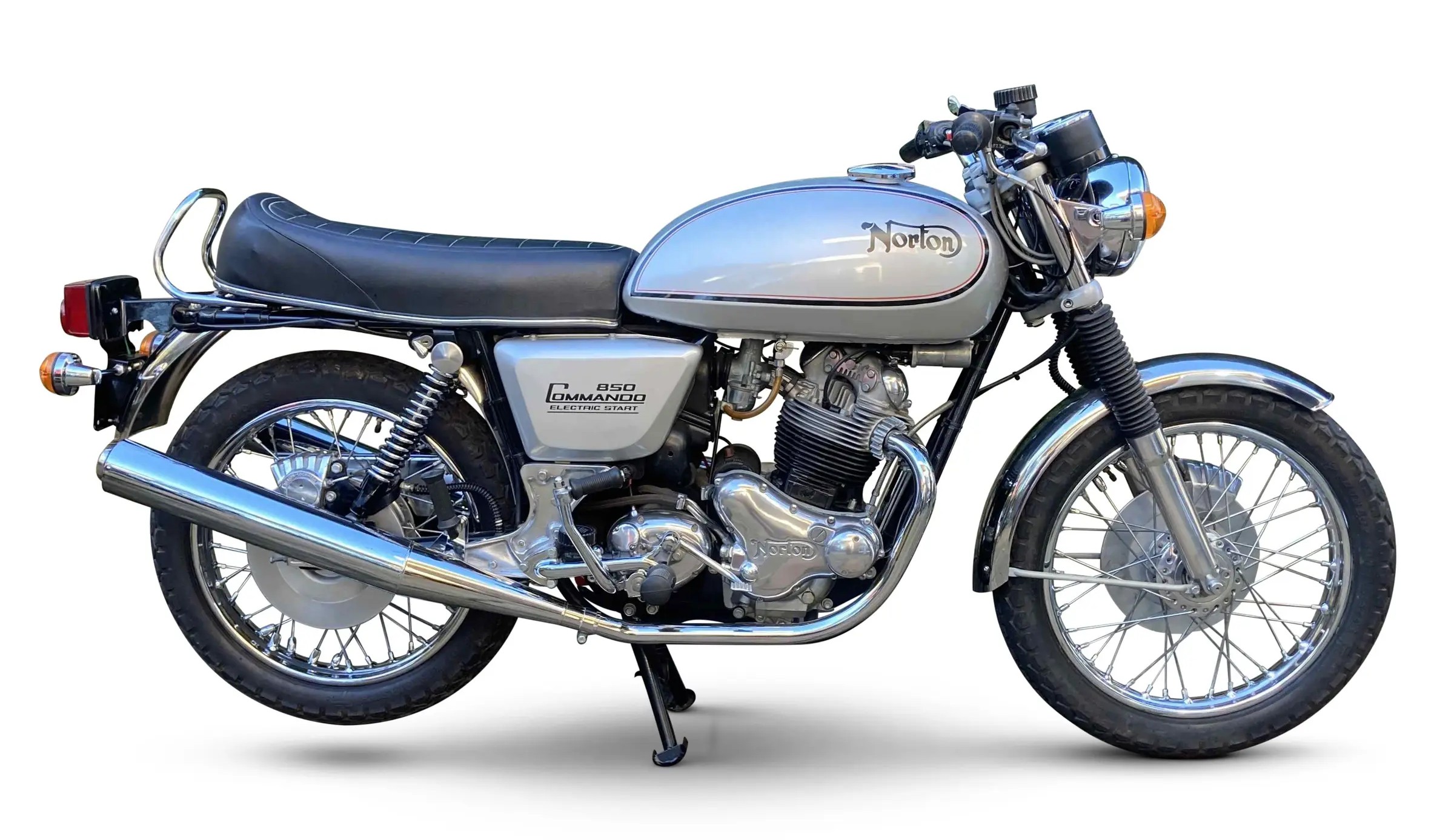
Norton Commando MkIII 1975
Meet the MkIII double-disc, electric-start Commando… and forget the oil on your white socks, the purple bruise on your right instep and the maddening vibration at cruising speeds. Dave Minton has found the new breed Norton is a lean, clean machine!
For years British bike enthusiasts have patiently tolerated oil leaks and inferior electrics for the sheer pleasure of riding some of the finest-handling road machines in the world.
Now, finally, the enthusiasts’ tolerance has paid off, because at last the rest of the bike is up to scratch. The new Nortons really are superb!
Although I have never been a fan of the big woofling twins, until now I think my doubts have been reasonably well-founded. In the past a hard-driven Commando soon became a shaky Commando. Blown gaskets, burned oil, leaked oil, turning bearing races — you could bet your boots that something would give out sooner or later. Fortunately, the new Commandos are different, and perhaps a little tale I heard accounts for Norton’s timely changes.

It concerns Dennis Poore and Hugh Palin, top executives in the Norton-Villiers-Triumph group. Poore is Chairman of NVT, a man of incredible determination and willpower who has seen his company through a traumatic period that would have defeated lesser men. That’s why I like this story and believe there’s more than a grain of truth in it.
Poore and Palin were motoring down through Italy to Imola a couple of years ago in Poore’s big Mercedes. A fast car that Merc, with a big fuel-injected V8 under the bonnet, and its occupants were making the best of its high speed cruising. Now, if there is one thing Poore understands it’s fast motoring, he being an ex-racing driver of considerable ability.
Just occasionally, a small group of hardened and experienced big bike pilots managed to get past him. Even more frequently Poore overtook gaggles of fast riders. Their speed was around 160 km/h. Poore said to Palin, “Why are none of them riding Nortons?” Palin admitted that Nortons were not popular with Continental riders because they would not cruise reliably at continual high speed.
On Poore’s return to England two things happened. Norton engines were considerably beefedup all round to get over the mechanical unreliability, and Bob Manns was made chief tester.

Bob is one of those rare men: the professional enthusiast. His riding dates back to the days when Britain won the ISDT and he was in the team on a Matchless 650. Being chief tester for Norton still means what it used to in the days when men like Edward Turner and Val Page were in charge of testing for their factories. They rode their products and took note of what their test riders told them. To be a tester then you had to be a skilled, analytic engineer with a bent for racing, and combine all this with incredible patience.
Such a man is Bob Manns. What he says goes, on personal command from Dennis Poore. Nothing passes the test department unless they agree. Bob rides every day in all weather, piling up kilometres like most people take breaths.
His effect on the Commando has been very noticeable. In two years it has emerged from its rubber suspended “Atlas” engined days into a punchy roadster of quality.
With the advent of the 850 two years ago, heavier and much stronger engine components eliminated unreliability, but oil leaks remained. Even they have disappeared and it now appears the new Commando is capable of cruising at 130 km/h plus as well as any other bike.

Major oil leaks around that old trouble spot, the chaincase, have been totally eliminated. In place of the centre nut housing is a more conventional series of periphery crosshead bolts. These combine with wider gasket joint faces to keep this area of the bike clean. On the other side of the engine the timing cover has also had its joint faces widened for the same reason. A third alteration contributing to the outer cleanliness of the engine would be the improvement of the lubrication system.
The oil pressure relief valve inside the timing case cover has also been modified. At low engine speeds, when oil is thick, high revs can build up extreme pressures in oilways and a by-pass valve has been built in to prevent this. It also discourages frothing during high temperature operation.

The latest crankcases are a new casting with more webbing around the new, bigger main bearings and also greater wall thickness. This is the second time this has been done to the 850 crankcases. The crankshaft has also been strengthened with heavier webbing.
The performance increase is due to an improved air cleaner and larger carburettors. Another old bogey, loosening or worse, cracking of the exhaust pipe flanges has been prevented by a special design that allows the pipe to find its unstressed position after the other attachments have been clamped up, and so remain free of fractures.
In the words of John Hudson, the factory’s most experienced maintenance and service engineer, “We’ve got it beaten now. There are no oil leaks anywhere, except maybe on the rev counter takeoff gearbox and that is next on our improvement list. It will be changed for the production models.”
Obviously, oil leaks have had to be eliminated with the decision to use a hydraulic rear disc, but no one except the marketing men seems to know why the disc is there. Evidently the public wanted it, so they got it, but I’m damned if I can see the reason why. The old drum unit was effective enough; nothing special, but what rear brake is for that matter? I leave my final judgment until I have ridden a lot of Commandos over a lot more ground in widely-varying weather conditions.

One of the more interesting changes has come about through the factory’s concern with private owners and racing teams. It was discovered that some machines offer improved handling with the front disc brake transferred from the right to the left side. Why this should be is a matter of conjecture but it’s real enough for all new bikes to come equipped as standard with left side disc brakes.
Even the engine breather has been painstakingly designed to stop every last misty particle of oil escaping. From the crankcase it is directed into the oil tank, where initial separation of the mixed oil/air mist takes place. Finer particles that do not sink into the main reservoir are then trapped, with the air, in a simple filter system. The trapped oil then trickles into the main tank. Clean air passes into the airbox which contains the ordinary air filter. Whatever remaining oil mist is still in suspension gets burnt.
It would have been easy enough for Norton to have simply stuffed the crankcase breather tube into the induction tract and allowed the engine to burn it all.
The improved system ensures that only the minimum of dirty air is inhaled into the combustion chamber. This guarantees greater efficiency.

Unlike its zippy cousin, the Trident, the Commando uses an American Prestolite starter motor. If you kick over a well-maintained, warm 850 Commando you will understand why the less powerful Lucas starter motor wasn’t suitable. It also explains why the Commando requires a 150W alternator to the Trident’s 120W.
The Isolastic mounts which encapsule the power and transmission train into a single isolated unit are well known enough to require no further explanation. The difference for the 1975 model is that they are supported by a duplex coil spring mounting at the front of the rocker box, just under the steering head. Aware that the three rubber bushes were to blame for vibration at low revs, Norton devised this complementary system to eliminate the low frequency, low engine speed resonance. Its damping effect is immediately noticeable. Not only is the low-speed vibration reduced but it dies away at low revs so that by the time the engine is turning freely at 2000 rpm it runs smoothly.
Some of this improvement can be attributed to the hydraulic slipper tensioner within the primary chaincase and, as all backlash is eliminated, the transmission of power is considerably smoother. The hydraulic pressure for the tensioner comes from the engine oil pump.

In fitting a duplex chain, Norton has killed a few dirty birds with one stone. The system offers increased chain life and also simplifies the fitting of an efficient tensioner, but a duplex chain can only be used with a fixed engine and gearbox unit.
Sliding gearboxes are a bind. They can move of their own volition if not correctly tied down and they make chain adjustment difficult. Norton has now bolted the gearbox firmly to the engine making it a type of unit construction. Because the Americans demanded a left side gear pedal, the old sliding gearbox would have been impossible anyway, as the pedal shaft now projects right through the primary chaincase just forward of the clutch. Like the Triumph system, it works through a long shaft which engages with the old selector mechanism at the other side of the transmission housing.
“Prod the starter button once only,” I was told. “If the engine doesn’t catch, release it immediately, wait a second, then try again.”
A valuable tip, because the big twin with its two big pots and huge flywheel has a strong inertia resistance. To spin the engine would need a much bigger battery and starter motor. Mike Jackson, Norton’s sales director, claimed the only starter motor powerful enough to spin the engine came from a V8 Cummins diesel and left no room for the engine itself!
Mike’s got a weird sense of humour anyway. The “prod” starting system allows the engine to rebound back from compression after an abortive attempt to fire it up. The trick seems to be to switch on the fuel, tickle the carbs and with the air lever shut just “pop” the engine over. No more.

With a hot engine, exactly the same applies but without the cold start procedure. I tried the kick starter crank as well, but only to prove it really worked. It’s strange, seeing a starter unit resembling the old magneto in exactly its old place once more.
Although the medium and top end power delivery of the Commando was good, it was the bottom end which most impressed me. Commandos always shook at under 3000 rpm but smoothed out when spinning freely. They no longer shake at low rpm because of Norton’s careful reappraisal of the unique “Isolastic” engine mounting and also the effectiveness of the new hydraulic primary chain adjuster-cum-auxiliary shock absorber.
Unlike its Trident stablemate, the Commando is definitely not a sportster. High speed cruiser if you like, luxury tourer, but without that indefinable sharp edge so vital on a true sports machine. Like so many modern big machines it escapes any clearly defined classification.
The power output of the Commando is best used at low to medium revs, like the Harley Davidson Sportster. Despite its stretch from 750 being in the bores alone, it is nonetheless a long-stroke engine with all its inherent punch and fun at low speeds. The optimum power delivery speed might well be 5900 rpm but I never went above 5000 rpm on the road. This felt like the least strained and most comfortable maximum. I have no doubt that 6000 rpm produces more power, but the high piston speed and super-low speed “umph” suggests that owners might be advised to steer clear of prolonged high revving.
The bike is geared for a theoretical top speed of 193 km/h. Crouching over the tank in a winter riding suit, however, the best I was able to get from the machine was 177 km/h at 5400 rpm.

Some danger lies with insensitive riders not appreciating that smoothness does not necessarily indicate a lack of stress. For this reason most guys are going to have to keep an eye on the tacho because there is simply no other way to gauge top cruising speed.
Acceleration in top gear was quite incredible. I have always favoured V-twins for their gearless method of fast riding, but quite honestly, the Commando is equal to just about anything around. From 2000 rpm in top alone, which is 62.7 km/h (39 mph), the thing pulls like a truck and even from below it. But from there on about the only way to describe acceleration is to call it massive. Not wicked like a Kawasaki Mach III, but a smooth liquidity of motion.
During a couple of initial acceleration runs I found it impossible to use the clutch because I simply could not let go of the handlebar. Then I learned that the clutch was unnecessary. This gearbox beats most five-speeders in nifty shifting, clutch or not. Yet because of the power style of the big twin, wheelspin in the lower ratios was extremely difficult to provoke.
The front end did become light during “limit” riding around fast curves when gear changing was attempted. Thanks to the wide power delivery period such a style was experimental only. No ordinary buff, however keen, is going to need the additional revs from a chop down to provide more power. It’s all there in top!
Handling, as always on Nortons, was impeccable. Roadholding too was entirely a matter of rider experience and not limited by any machine traits at all. Stability was much better than I have experienced with a good many other Nortons and I think it might stay that way.
Until now old Nortons, plus a few new ones, have that nasty built-in shimmy induced by slack Isolastic bushes. The trouble with press test bikes is that they all have correctly-shimmed rubber bushes and the rubber is new and therefore firm. Unfortunately, their engines are often not fully run-in either, which generally results in the test report suggesting a much more stable yet slower machine than a well-used Commando actually is.
Like most European motorcycles, a Commando is not properly run-in until it has covered at least 6500 km, by which time its Isolastic mounts are sloppy. I was never more amazed than when I borrowed a factory “hack” for a few weeks not so long ago. It had 8000 km up and that thing tramped on! It was so fast I thought the speedo was wrong, whereas all I was riding, for the very first time, was a well-worn 850.
Wisely, Norton has slung out the shim system of adjusting the Isolastic bushes. Now a coarsethreaded cone, adjustable by means of a simple peg issued in every toolkit, takes up the slack. Time taken for each bush is said to be less than a minute. The effect could be to ensure that the new Commando’s stability will not deteriorate with age, due to the easy new adjusting method.
For all that I did notice the tiniest twitch during fast cornering and power changes induced by whatever method, including gearchanging. It was much less serious than anything Japanese, for instance, but more noticeable than a Trident or Ducati reaction.

If anything, the Commando was faster than the Trident around ordinary roads at speeds up to 128 km/h (80 mph) purely on the strength of its lighter weight and superior engine power low down.
Fuel consumption was pretty good. Normally I got slightly better than 17.7 km/l. Faster stuff (on private roads you understand, chaps, private roads…) reduced this to 10.6 km/l.
Thanks to Lucas’ excellent new switchgear incorporating all the essential switches used during riding on the left side, leaving the right hand free to grapple with the brake and twistgrip, at last Britain seems to have reached success. Without exaggeration, it’s the best switch setup I have used in many years of riding.
The quartz-halogen headlamp is truly brilliant, the riding position more comfortable than ever before thanks to footrests put almost 25 mm rearward from previous positions, the silence of the bike is bettered only by BMW, and its smoothness is uncanny.
All in all it’s a great package that at last is going somewhere. I had my reservations about Commandos until recently, but the MKIII is something else.
It’s not just “excitingly traditional” now, but very practical as well!
By Dave Minton, Two Wheels, October 1975

It seems that the numbers of classic British bike enthusiasts are dwindling, if the softening of 1960s-1970s Norton and Triumph prices in the past couple of years is an indication. At bikesales.com.au you’ll find an eclectic selection of Commandos priced (at the time of posting) from $13,500 to $35,500.