Yamaha XS1100 1978-1982
Until the XS750E arrived earlier this year (1978) it was hard to be even slightly impressed by any big-bore street Yamaha. Despite unparalleled successes in many phases of motorcycle sport (motocross, road-racing, trials, flat-tracking…) and top-selling models in a host of classes (trailbikes, small commuters, small and mid-sized sportsters, motocrossers, trials machines and roadracers…), the company had never built a really successful, large-capacity street bike.
The long running 650 twin has a few stalwart fans, but on its merits as an updated British parallel twin, not as a worldbeater like Honda’s famous four. Yamaha’s short-lived TX750 twin and early XS750 triples were just too soft to cut it.
But why this designed-in gentility?
A misconception — one which Yamaha has only now relinquished — that people buy big bikes essentially to tour on and top performance isn’t necessary.
Wrong!
People buy half-litre and bigger bikes primarily because they perform better; other reasons come second. And these buyers discovered other factories’ big guns were a good deal faster and sportier and still made acceptable tourers. While Yamaha sold a few 750s to die-hard tourers, its opposition has sold hundreds of thousands of 750s (or larger models) to everyone else.
Still, beneath the dull, original XS750D lurked Yamaha’s first true four-stroke sportster. The second update – the XS750E — has more than enough beans to pull the skin off a rice pudding. In fact, it’s almost as quick as today’s fastest 750s which weigh less, have one more cylinder and no shaft drive.
The XS750’s development helped ensure new Yamaha’s XS1100E flagship would be no slouch. And that, above all else, is true. The XS1100 cannot be called slow — not by any stretch of the imagination.
Yamaha claims 78.3 kW (105 hp) at the crankshaft, although it is hard to find this figure in print nowadays, and our dyno test suggests it is accurate. The XS1100 is the first shaft-drive bike to offer motorcyclists the absolute ultimate in performance. The best BMWs and Guzzis, the Gold Wing and other shaft drivers are all significantly slower than the quickest chain-drive bikes. Not so the big Yamaha.
It laid more rubber at the dragstrip and pulled more horsepower on the dyno than any other bike we’ve ever tested. It also weighs more, and this stopped it being the absolute quickest over the standing quarter…but there’s very little in it.
Okay. So Yamaha’s XS1100 must really be some bike to be a super-smooth tourer (we say that after 4000 km) and a macho, ballsy sportster at the same time. All we can say is “It is. It is.”.

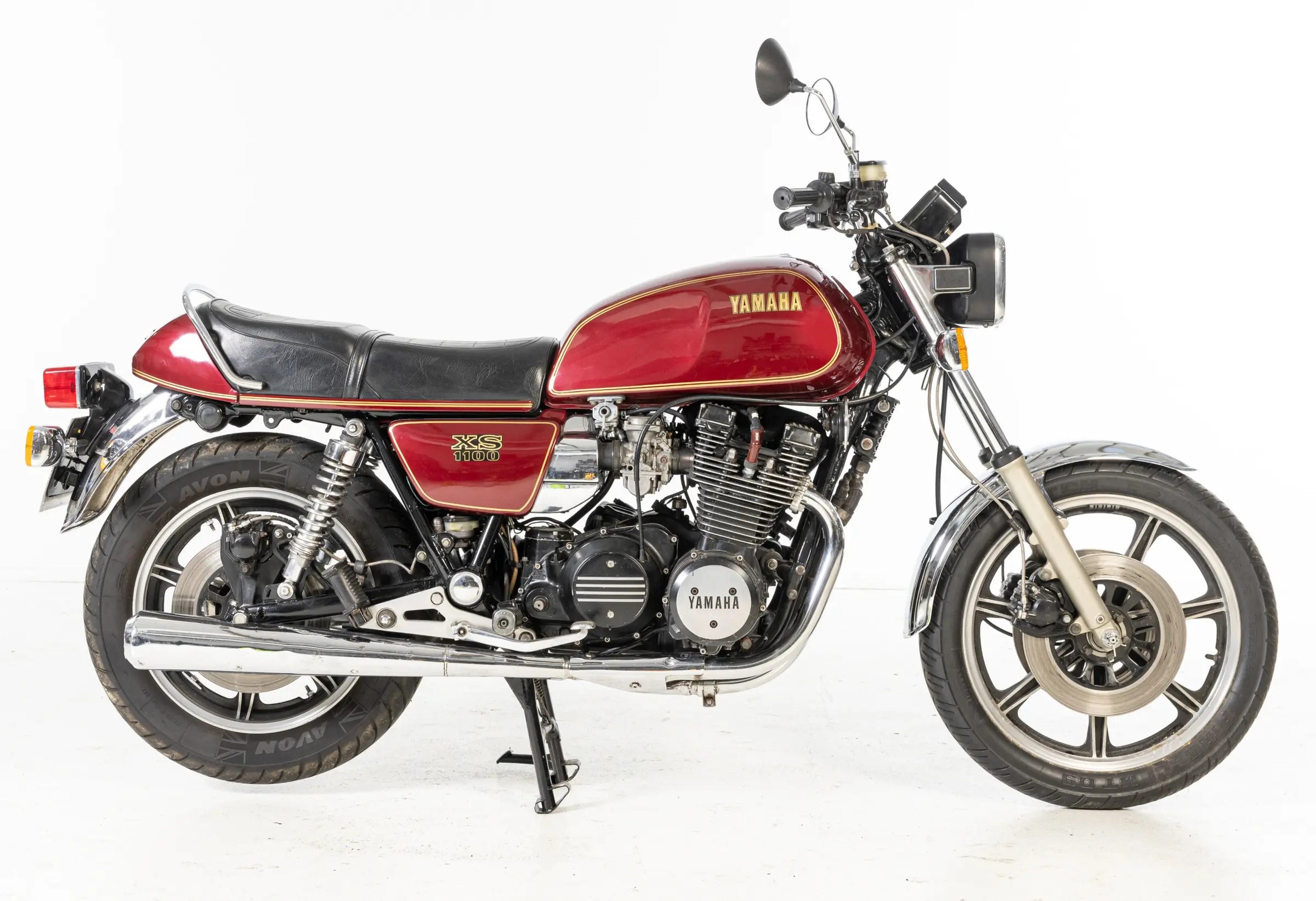
Weighing in at 282 kg (620 lb) all fuelled up and ready to roll, the big Yamaha is an imposing sight in the flesh. The bulbous, broad tank (with a little dent in it for the engine’s rear cam), the huge engine/transmission unit, the very broad seat and the sheer solidness of the whole bike (the footpegs look like they could support five tonnes each) only emphasise the initial impression of sheer massiveness.
So large is the physical presence of the bike that it’s the uppermost thought during the first ride. “Hell, if this thing gets out of shape at all there’s no way I’ll get it back under control.”
First impressions are often inaccurate and fortunately the concern over the XS1100’s ability to forgive rider error is unfounded.
Nonetheless, riders who had their first experience around tight suburban streets were considerably less impressed by the big Yamaha than those who were introduced out on open roads and had time to adjust to the bike before encountering tighter conditions. Nearly a week was required before our riders felt completely at home and able to cope with anything on the big XS, compared with maybe an hour on Suzuki’s GS1000 and a day or so on the Z1-R Kawasaki.
We rode two XS1100s over about seven weeks. The bike on which we ran performance figures was equipped with Metzelers, the other (basically for photography) with Avon Roadrunners.
During any road test there will be times when one or several riders must ride under difficult conditions. Implicit in the definition of “test” is some hard riding of the motorcycle and invariably a test bike will lock a wheel or two during the crash stops, drift a back wheel while being cornered hard or get a bit crossed up at the dragstrip. It is the ease with which a tester can maintain control under such conditions that gives a pointer to whether a bike will help get a rider out of trouble or not.

We emphasise that because it is absolutely essential for a bike with the weight and power of the XS1100 not to work against the rider in desperate situations. We found, on more than half a dozen such occasions, that the XS1100 fitted with decent tyres (we can’t speak for the standard rubber) behaved impeccably, just like the GS1000.
Which brings us to the next important point: Why so many on the edge occasions?
The brakes weren’t prone to locking and the bike wasn’t too much of a handful at the dragstrip. The truth is many of the heartquickening situations occurred on public roads and that is unusual. They mainly happened early in the test period, but after the initial familiarisation time.
The main problem is wheelspin — excessive, dry-road wheelspin.
The reason the wheelspin problem is so much worse with the XS1100 than with the Z1-R (which is also very powerful and quite heavy) or GS1000 is primarily its peaky power delivery.
Wheelspin is not a problem if the road surface is perfect and the bike vertical, but in everyday riding roads are frequently encountered which are a little damp or a trifle oily and only the slightest hindrance to perfect traction is needed when the tach hits 4500 rpm to send the the XS sideways and fishtailing down the road. Even a painted white line is often enough to start wheelspin; once traction is broken a complete back-off is necessary to re-establish the desired intimate contact between tar and tyre.
Needless to say these wild smokies and subsequent back-offs are somewhat embarrassing if you’ve just chortled down the left lane at a set of lights, intending to drag off the traffic before you get to the parked cars ahead. It’s even worse if you are between two fast cars!
The XS1100’s cammy engine, combined with its lowish gearing (for a one-litre bike) is also quite capable of sending the front wheel skywards at a hump in the road as the needle crosses 4500 rpm in spite of the bike’s massive weight. It’s definitely a bike for experienced riders only, much more so than the GS1000 or Z1-R.

Technologically, the big Yamaha is the most advanced motorcycle in the marketplace. Almost every worthwhile advancement of the past few years is incorporated in the XS1100 along with unique extras. In addition to the mandatory three disc brakes and cast alloy wheels, the XS boasts breakerless ignition, automatically cancelling blinkers, quartz iodine headlight, the best instrumentation we’ve found on a motorcycle, a front brake lever with freeplay adjuster, extensive use of Allen screws on the engine, dual horns, a fuel gauge, oil cooler and shaft drive.
Three bright new ideas debuting on the big Yam are three-way preload adjusters for the front fork springs, a pendulum-type kill switch (in addition to the manual kill switch) which automatically isolates all the electrics if the bike leans more than 60 degrees to one side and an electric tachometer driven by pulses from the alternator. The engine of the XS is extremely responsive and the response from the electric tacho is even more remarkable. We waited for the needle to bend!
In all the XS1100 offers a lot for about the same price as the Z1-R and the Suzuki GS1000, although the Kawasaki offers more style and the GS more handling and steering sophistication.
A transverse, air-cooled, dohc four-cylinder four-stroke of 1101 cm3 supplies the power. Fractionally oversquare and equipped with an oil cooler, the engine’s state of tune can be guessed from the 9.2:1 compression ratio and four healthy 34 mm Mikuni CV carbs.
Similar in most respects to the XS750 engine, the 1100 motor uses a one-piece forged crank and plain bearing lower end. Ignition is through an electronically trigggered battery coil system and the primary drive is by Morse Hy-Vo chain from the crankshaft centre. Efforts have been made to keep engine width to a minimum and in this regard the 1100 is no worse than its one-litre competitors.
The engine is finished in an easily-cleaned black paint which resisted chipping better than most engine blacks. Yamaha has rubber-mounted the entire engine/transmission unit and the result is a slight amount of shaking in the 1000-1500 rpm range. It doesn’t annoy the rider at all, rather it establishes reality in the face of the uncanny refinement everywhere else. Cruising in the 85-120 km/h range it’s particularly smooth, just where you want it.

A light throttle action is easy on the wrist while touring. Who needs positive closing cables anyway? Mechanical quietness is also a virtue. The exhaust gets up a sporty growl at high revs which is rather pleasant and not overly loud. Another strong point is the engine’s terrific responsiveness. It’s just as well missed shifts are only annual events.
On the negative side, the 1100 is very slow to warm up on winter mornings and you’re faced with a 2000 rpm idle and normal response with the two-stage choke half on or an utterly gutless engine with the choke off for about 15 minutes. For big city-based riders commuting to work on winter days, a wired-on oil cooler cover would reduce wear by allowing the oil to reach normal operating temperature faster.
No high performance litre-plus motorcycle is going to be economical. Average test consumption of 12.7 km/1 (36 mpg) is fair. The Z1-R was considerably more economical at 14.8 km/l (42.1 mpg) and the GS1000 slightly better at 13.8 km/l (39.2 mpg). Touring on big Yamaha gave 14.3 km/l (40.7 mpg) and a passenger made almost no difference to the engine’s thirst. The 24 litre tank allows a 290 km cruise before reserve is needed and the fuel gauge provides a continuous indication of tank content. While the fuel tank appears high, wide and bulbous, it causes no discomfort whatever to the rider — a simple illustration that functional capacity is more important than a fuel tank’s looks. Kawasaki, please take note for the Mark 2 Z1-R.
The big XS took the dyno run in its stride, not even idling fast at the end of the session, although the exhaust collectors under the rider’s footpegs in front of the mufflers blued slightly and the rear tyre’s surface melted quite badly. Peak power of 57.4 kW (77 hp) at a corrected 8500 rpm was the highest we’ve ever recorded, comfortably overpowering the Kawasaki Z1-R (54.4 kW) and Suzuki GS1000 (54.7 kW) in the pure muscle contest.

Torque peaked at 72.6 kW at 5000rpm, also well ahead of the Z1-R and GS1000. The only bike we’ve ever dynoed to even come near this gigantic output was a Ducati 900SS with 40 mm carbs and Conti megaphones a couple of years ago. The Duke managed 68 Nm at 5000 rpm (and 41 kW at 6750 rpm). The GS1000 produced the most torque out of the XS1100’s main competitors — 61.7 Nm at 8000 rpm.

Enough of the absolutes, let’s look at the shape of the power and torque curves. Unlike the dynamometer chart curves for the Suzuki and Kawasaki, the Yamaha’s power curve shows a steep rise in the 4000 to 5000 rpm range and then a levelling off until about 6300 rpm when it starts rising again. This “bulge” in the power curve corresponds to the sudden increase in mid-range power we felt at around 4500 rpm when riding the bike on the street. The Yamaha makes less power at 2000 rpm than the Suzuki and this, combined with the extra weight of the Yamaha (35 kg), makes the XS feel much less responsive than the GS1000 in the 2000 to 3500 rpm range. The steep, mid-range rise in power causes the torque curve to peak at 5000 rpm and with the amount of torque available at these revs it’s no wonder the back tyre is hard pushed to maintain traction.
At the dragstrip, the XS1100 turned a best run of 12 seconds flat over the 400 metres, at 178 km/h. That’s the same time as the Z1-R and 0.2 seconds slower than the GS1000. We tried hard to put the XS into the elevens, especially after reading about sub-11.8 times in an American mag, but our bike just couldn’t do it. We should point out here that we run at the strip with whatever tyre is fitted at the back and never drop below the lowest pressure recommended for street riding, a tactic sometimes used by makers and testers to maximise launch grip. In our view very low pressures don’t give much guide to the bike’s ability in registered form, so we run our bikes at the strip like you’d run them — as they come.
The Yamaha proved a fraction slower off the mark than its lighter competitors (0 to 100 km/h in 4.4 seconds), but was quicker than the Z1-R once underway thanks to its lower gearing and closer ratios. Best times were obtained by dropping the clutch at 6000-6500 rpm and changing gear at 9000. The bike was still in fourth through the traps at the end. Slow times on several occasions resulted from using too many revs at the start and spinning the rear wheel for ridiculous distances. One black tyre mark was more than 30 metres long!
Nine and a half seconds was all the XS took to reach the Imperial ton (160 km/h), not bad when a recent Porsche 911 Turbo test shows this $65,000 car taking 12.9 seconds to accomplish the same thing.
The XS1100 gave no problems at the strip and was easy to run. And you don’t have to worry about chains breaking.

We found some practice was necessary before smooth gear changes could be achieved all the time. Even so, most one-two changes (and the odd two-three swap) were punctuated with clacks of various loudness. Other changes were excellent and false neutrals non-existent. The clutch was light in operation and slip could be well controlled. Dragging had no adverse effect on the clutch.
Gear ratios are well-chosen, but overall gearing is a little low as redline revs in top was only 204 km/h. Our top speed of 216 km/h was achieved by running the bike to 9000 rpm in top (stability at 200 km/h was excellent) and the bike probably would have pulled 220 km/h with more overrevving. Drivetrain freeplay never really bothered us except in first or second gear. The overall lash is about the same as for a chain-driven superbike.
Steering was noticeably affected by the tyres fitted. With the Metzeler on the front the XS was a huge self-steerer (more so than any other bike we’ve ridden), but with the Avon these self-steering tendencies were much reduced. The bike could be more accurately manoeuvred at low to medium speeds, so the Roadrunners certainly suited the bike more. It’s surprising a front tyre alone could make such a difference. Both the Metzelers and Avons gave first-rate adhesion.
Even with the Avons fitted though, the Yamaha’s steering lacked the precision and neutrality of the Suzuki GS1000. Overall we rate it as average — the same as the Z1-R’s steering.

Supple suspension and generous wheel movement give the rider (and passenger) a very comfortable ride, keeping road shocks where they belong — buried undetectably in the suspension travel. So cush is the ride on the lowest front and rear preloads one can’t help but expect the lurching and wallowing that invariably accompanied such a soft ride five years ago. Surprise, surprise! Wallowing and wiggling just aren’t part of the handling package. The machine could be pushed hard on bumpy bends without ill-effect, and this is one area of handling where the Yamaha completely outclasses Kawasaki’s Z1-R.

Both the Avon and Metzeler (and even the standard rear tyre) only just fit between the swingarm forks so not much up-sizing of the rear tyre from a 4.50 x 17 is possible. Fortunately the bike comes with excellent ground clearance; all the underpinnings and the low mufflers are well tucked in (excellent design work!) although the centrestand could be easier to use.
On fast bends with sizeable dips the merest hint of lurching is noticeable and, if the rear shocks are hot, a slight trace of pogoing, particularly if the rear units are set on the minimum preload. But even one or two preload settings higher at the back still yields a comfortable, supple ride. The sheer mass of the bike and high unsprung weight at the back (shaft drive, gearcase, disc brake and cast wheel) are possibly just a little much for the spring/damper units fitted, although their performance is still better than most, even if not quite up to the GS1000’s high standard.
Flicking the bike from hard-over one way to hard-over the other through an S-bend is slow and fairly heavy work, although all normal cornering can be accomplished with only very slightly more than normal big bike effort. Hauling the XS in and out of parking spaces is also an effort, since the drag of three discs plus shaft drive first has to be overcome as well as the model’s ever-present weight) and it’s just as well the wide seat is no higher than it is. Never mind, the bike’s colossal size has other useful attributes, like impressive crosswind stability and excellent behaviour while carrying a pillion.
The three hydraulic disc brakes do an excellent job of hauling the big Yamaha down from speed while providing good feel with ample power.

Recorded stopping distances were about the same as the Z1-R’s although lever and pedal feel on the XS was a good deal better. The GS1000 stopped nearly two metres shorter from 100 km/h but this was an outstanding stopping distance and we really have no complaints about the XS1100’s brakes. Fade resistance was average (which is to say quite good) and stability under severe braking very good.
The rider is comfortably catered for with a luxurious seat and a relaxed riding position. Smaller riders had to stretch slightly to reach the lower BMW-style bars, but none reported any problems and the handlebars’ sensible positioning soon became apparent after 10 minutes at 140 km/h.
The XS is one of the best bikes made for two-up work. The wide, soft seat and excellent ride compliment the bike’s outstanding stability and ground clearance two-up. As far as the rider is concerned the bike is less affected (in terms of handling and steering responses) by the extra weight at the back than any of its competitors. The lack of engine vibration is another bonus for long distance, two-up, touring fans.
We didn’t particularly like the twin horns which still aren’t loud enough (check Honda’s CB750F2 horns), the non-lifting seat, and the positioning of the “Park” setting on the ignition/steering lock at the end of the anti-clockwise turn. It was too easy to intend to turn the key to “Lock” and go right past to “Park”, leaving the tail light burning.
On the other hand, we did like the adjustments provided for front brake lever freeplay and front fork spring preload, as well as the excellent rearview mirrors, switches, instrumentation and lighting, the better than average toolkit, the comfortable (but smallish) handgrips, the attractivelyshaped rectangular blinkers and the overall quality appearance. The XS1100 gave everyone an impression of solidarity and quality. We think the bike will last well.

For now, the Yamaha is a real state of the art motorcycle, combining the best points of sportsters and tourers, although the bike is definitely more a sporty tourer than a tourable sportster. Because the power can sometimes be a bit much for the rear tyre, we’d only recommend the bike to people riding 650 or larger motorcycles at present, and we’d very strongly suggest Sydneysiders take Len Atlee’s excellent advanced riding course as well.
In spite of the frequency with which buyers will have to replace the back tyre (at least there are no expensive chains to periodically renew) we also think the bike represents very good value for money.
By Colin Miller, Two Wheels, November 1978

Guido from AllMoto has a whole bunch of XS1100 good stuff here including ABC video of the 1978 Castrol Six Hour, plus an Australian Motorcycle News ride on the restored race winner.