The 1976 Australian TT
The atmosphere of a race meeting is one of the most critical yet hard-to-define qualities. Often it’s compounded of tradition and the realisation of a meeting’s history. The Isle of Man TT is the prime example of this, while to a lesser extent Bathurst has the same effect on the local scene.
Yet history alone doesn’t suffice. There are other factors which, if favourable, can give even a brand new meeting on a brand new track a quality of almost electric atmosphere. The 1976 Australian TT meeting, held on a temporary circuit at the Laverton RAAF base just outside Melbourne, was one such.

The weekend had a lot going for it, of course. The racing was close and fast (although not exceptionally so), the weather was perfect, and the lineup of riders included 15 internationals. Of these nine were Italian, headed by the incomparable Giacomo Agostini, the current 500 cm3 World Champion, and backed up by the title-holders in the 125 cm3 class (Paolo Pileri) and 250 cm3 class (Walter Villa).
The bikes themselves contributed to a memorable meeting. An MV rider won the world title for 17 straight years before Ago — having broken a long association with the Italian concern — won for Yamaha in 1975. The power and handling of the mighty four strokes had at last been overtaken by the two-strokes, although it took an exotic device in the shape of the YZR500 four Yamaha, ridden by Agostini, to turn the trick.
Now, of course, Yamaha has pulled out of factory support for the GPs, and Ago is back with MV on a privateer basis. The Yamaha has disappeared, but a threat to the bike still exists in the form of the RG500 Suzuki, which is being made on a limited production basis.
None of this detracted from the aura surrounding the Italian four; not even the entry of eight of the new Suzukis in the 500 TT could lessen the impact of the MV. If anything, they heightened it, for the bike took the grid in the event as the single four-stroke against the two-stroke hordes.

That the Japanese bikes proved to be slightly faster and have better handling than his machine didn’t faze the champion. Major revisions to the frame promise to improve the handling out of sight. Since its introduction in 1972, the power of the current MV four has been steadily increased until in 1975 it proved far too much for a rather ordinary frame. Agostini is confident that the new chassis (which he had hoped to bring to Australia) will turn the trick, and the MV will win its 18th world 500 cm3 title.
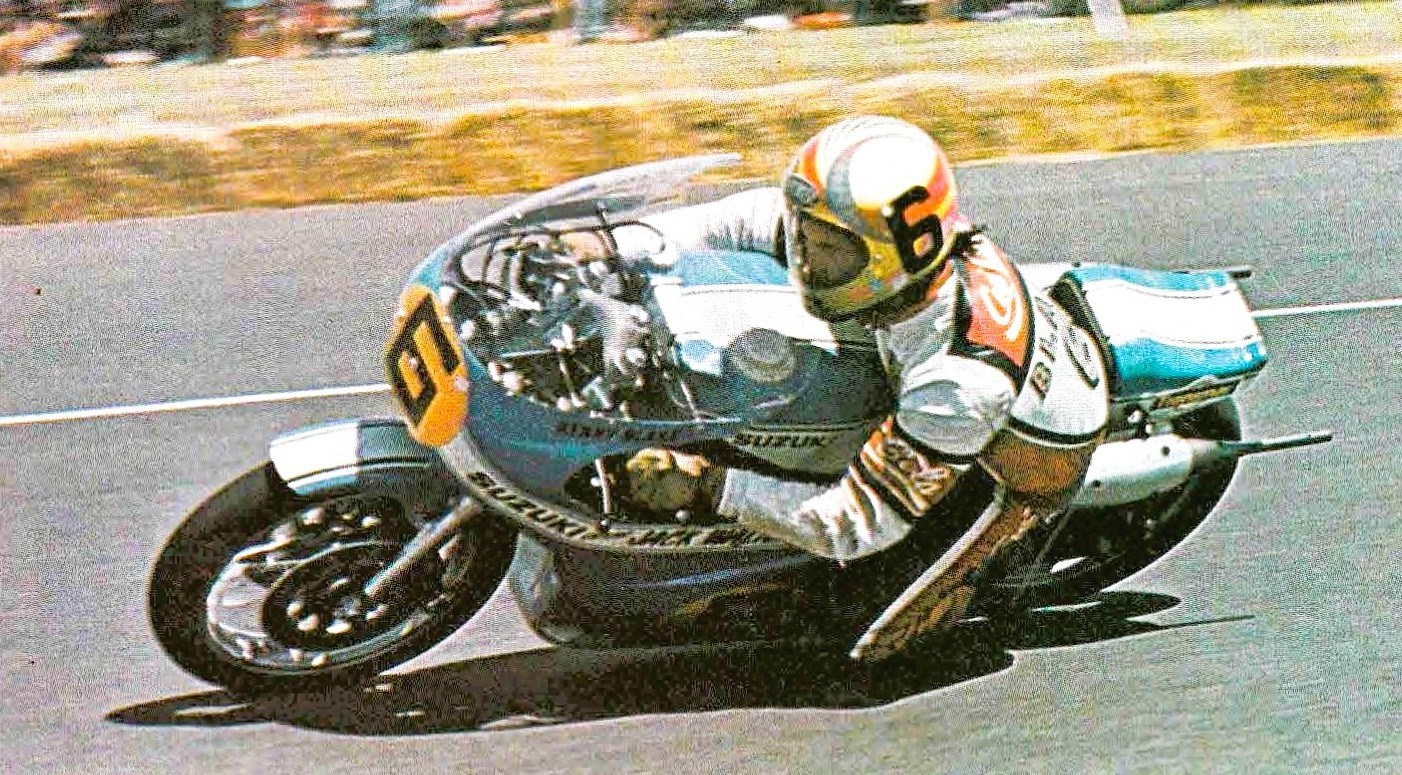
Whatever the outcome, the Suzukis will prove formidable opponents. The four-cylinder motor is arranged in a square formation, effectively one twin behind another. The cranks are coupled to a primary drive gear and through to a six-speed gearbox. The water-cooled 500 is a neat, business-like and modern machine, made all the more attractive by bold styling on the fairing, tank and seat and Suzuki’s current racing livery of blue and white.
The design is new, and still subject to some teething problems. The bikes entered for the Australian TT suffered several seizures, while John Boote’s bike sheared the water-pump drive, eliminating his chance at the world champion. There have also been reports of a recurrence of a problem faced by the TR500 watercooled twin — that of cracking brake discs.
However, none of this detracts from the model’s exceptional ability. It is light and fast, and handles very well. For the most part its engineering is typical of Suzuki products — sophisticated, strong, and well thought out. The riders were uniform in their praise of the way the bikes handled the circuit. Though long (4.5 km) and fast, the Laverton track also has some tricky sections where a good bike and rider can pick up time lost on the straight by a 10 kW power disadvantage. That the Suzukis give best to no other 500 machine in the herbs department makes them a formidable weapon.
Ken Blake was completely sold on his new model following Saturday practice. In fact he had fallen in love with the machine after his first sight of it, at the Indonesian GP last December. His bike had arrived in Australia only days before the meeting (as did ones for fellow Victorian Greg Johnson and NSW rider Laurie Barnett), yet on the Saturday Ken was able to garner fastest lap and pole position.
“There’s a bit of a bump halfway through the Carousel,” he said, “and you have to back off a fraction. The bike shakes its head for a second, but as soon as you get the power on again she settles down straight away.”
Significantly, Agostini was having to run on trailing throttle through this section and at another bumpy spot midway through the left-hander onto the main straight. Expect to see Blakey concentrating on the 500 class from now on. He has never been fully at ease with the booming power of the TZ700 Yamaha (although his performances on it have been far from ordinary). Now he has the Suzuki (and the scalp of Agostini) he’ll be a force to be reckoned with. On tighter circuits the 500 may even throw a scare into the top Unlimited machines.

On the track, Giacomo Agostini is just another rider on another bike. He can, and has been, beaten. But such is the domination he’s exerted over the scene for the past eight years that beating him is still unusual, and a high spot for even a very good rider. The situation is even more pronounced in Australia, of course, and Ken Blake put himself firmly into our racing history with his win at the TT meeting.
It could have been Stewart Avant, with an even more solid break on the field. The young New Zealander whittled down the first lap lead held by the MV (the bike fired and Ago was away well before anyone else was mobile) and passed him midway through the tricky left-left of the Carousel before the Pit Straight.
This was at the end of lap two; for 10 more laps the Suzuki drew steadily ahead and looked to have the race in the bag. However, few things trim the speed from a racing machine like a lock-up, and it was this which dumped Avant on his ear as he rounded the tight BP hairpin at the end of the main straight.

In the meantime, Blake had been riding in his usual spectacular fashion to pass Agostini and establish a short breathing space in second. A little further back, Greg Johnson was riding one of the races of his career in an attempt to catch the MV, but he found the 20 metre gap too much to bridge. Blake went on to a well-deserved win and a tumultuous reception from the crowd.
The world champion had tried hard during the race; there was none of the casual riding which underscored his wins at Calder during his 1971 visit, and allowed Bryan Hindle to snatch the break which led to his famous Oran Park victory. Coming from wintry Europe, Ago may have found Melbourne’s 34 degrees temperatures a strain, but he made no excuses: Blake, Avant, and their Suzuki fours, had his measure on the day.
It was a day for machines that had barely been pulled from the crate, for national champion Gregg Hansford had earlier posted a win on a brand new water-cooled KR750 Kawasaki in the Unlimited TT. None of the Italian visitors were riding in the race, but it was given a strong international flavour (and some unbelievable racing) by the entry of Pat Hennen. The likeable Californian is one of the hottest road racing properties in the USA, twice winner of the tough New Zealand Marlboro Series and a Suzuki team rider during the 1975 season.

With the factory out of direct involvement in American racing, he is, like most top US riders, unsure of the future. But he’s campaigning the works 750, a lean and capable projectile which seems to be the only thing able to halt the Kawasaki tide in local racing. Certainly he proved to be Hansford’s nemesis in the last Marlboro series, but the pair are so evenly matched you can guarantee fun whenever they line up on a grid together.
From the time the field was flagged away by the Prime Minister (lending official approval to road racing as well as having a great time himself), the race belonged to Hennen and Hansford. The Kawasaki had the edge in power and speed but the two bikes stayed together through the gears until midway down the straight, where the green machine’s superior oomph started to tell.
Gregg had already ridden a water-cooled 750 at the Ontario meeting in California in the latter part of 1975, but this was an even more advanced machine. Two days previously Team Kawasaki had got word that it was to be included in the official works team to contest Daytona, and possibly the other rounds of the FIM Formula 750 Championship. The bike had been set up specifically for Daytona, and incorporated all the latest modifications, many of which team manager Neville Doyle had pioneered during his successful 1975 season with the Australian air-cooled models.

Gregg reported that the new motor had the same power, but a different sort of powerband. “As the air-cooled motor got on the power it seemed to increase as the revs went up,” he reported. “With this motor it starts off strong and stays consistent. There’s no more or less power, just a different sort, and you have to adjust your riding technique to allow for it.”
The bike is nearly identical to previous models in the frame and running gear, apart from a minor rerouting of tubes around the steering head. Neville Doyle has a few more tricks up his sleeve for the motor department before Daytona, and there was no time before the TT meeting to set the suspension up properly. Accordingly, Hansford found the handling not as good as he would have liked, and Hennen was able to outride him through the tighter parts of the circuit.
But what a race it made of the Unlimited! During the 15-lap journey the lead changed at least a dozen times, the fearless Californian trying a bewildering variety of lines in order to outfox the Australian, but having to give best to the Kawasaki in the long straight, down which the bikes were pulling over 270 km/h.
Then, two laps from the flag, a slipping clutch spelt the end of Hennen’s bid. There was no way he could gear the bike properly for the 180-degree BP hairpin and maintain a competitive top speed. He had gone for the higher gearing, which called for some clutch feathering as he accelerated away from the hairpin. This took its toll, and the bike slowed gradually in the closing stages.

Not enough to put second place in danger though: the pair had established a 25 second break on third man Warren Willing, not yet back to his best form after a long period without consistent racing. And Warren himself was comfortably ahead of a group of Ken Blake, Stephen Klein, Greg Johnson and Rob Madden, all on TZ750 Yamahas. The action had been fierce in this area in the early stages, with the Yamahas of Bob Rosenthal and Dave Burgess also involved, but Burgess lost the front brake on his machine and crashed gently into the straw bales lining the approach to the Carousel, while Rosenthal was gradually whittled down by the others and settled for eighth. Klein harried Blake for several laps and eventually passed him to take fourth, while sixth was contested to the end by Johnson and Madden, with Johnson eventually taking the verdict.
As an overall meeting, the TT had great depth. Each race had its share of interest, even if overshadowed by the 500 and Unlimited events. In fact, the promoters probably didn’t get full potential mileage out of the rest of the Italians. Visits by Agostini outside the Continent are rare, and tend to overshadow everything else.
The Diemme riders were a case in point. The team for the TT consisted of Otello Busherini, third in the 1975 350 World Title, Giovanni Proni, Italian national champion, and Marco Luchinelli, who had been brought in at the last moment to replace the injured Attilio Riondato.
All are fully sponsored, riding Yamahas for the team which is backed by a syndicate of Italian businessmen. The bikes they brought to Australia were TZ250 and 350 models, for the most part sporting special frames and swingarms and non-standard supension. On their own the Diemme group would be a crowd-puller, for the three were more than capable of matching and beating the best that Australia could throw at them. They are proof of a greater public interest in the sport on the Continent than in Australia, and have the chance to compete in many more important meetings as a result.

Even more professional were the works groups from Harley-Davidson and Morbidelli. The Italian factories have never ceased in their bids for top honours in the world titles, and these two are proof that application and dedication can pay off, even to the extent of pinning down the Japanese steamrollers. Europe is motorcycling’s boom area at the moment, and both firms are committed to a program of racing involvement and the production of over-the-counter racing machines.
Both are also riding high on the strength of 1975 title successes (H-D in the 250 bracket) and although the Harley-Davidson concern is nominally American, the racing division has many of the personnel from the old Aermacchi days, before that firm was taken into the AMF empire. Stock ownership may be concentrated on the other side of the Atlantic, but the racing effort is Italian to the core.
The Morbidellis are typical of the many small firms which vie each year for honours in the smaller capacity classes. The group is atypical in the degree of success they’ve achieved, and the ambitious plans held for the future. Signor Morbidelli runs a factory which produces woodworking machinery. Building world championship racers is a sideline, albeit one to which he has poured seven years and a lot of money.
Things came right in 1975 for the natty little water-cooled twins with a first and second in the titles, and the future holds even more — for at the end of last season Morbidelli announced a manufacturing tie-up with Benelli Armi, the family concern which makes expensive shotguns. The firm also produces proprietary parts (mainly frames) for many of Italy’s bike manufacturers, and was of course the home of the original Benelli motorcycle concern. The Benelli line and name was sold some years ago to Alesandro de Tomaso, and his firm is part owned by Ford, which in turn . . . complicated place, Italy!
The Morbidelli/Benelli Armi agreement calls for Morbidelli to develop the bikes, and Benelli to build them on a limited production racer basis. At first it will be the successful 125s, then progressively into the 250 and 350 brackets. Like H-D, Morbidelli hopes to best Yamaha at its own game of offering top-class bikes for the privateer.

That was one of the keys to the atmosphere at Laverton. Not only was the incomparable Agostini present, but full works teams, with their unique machinery and world champion riders. It was a slice of the Continental Circus picked up and dropped down on the outskirts of good ol’ Melbourne, Oz. It was a rich diet, one which we’ll probably have to try more of before we fully appreciate it.
And the teams were treating the Australian TT seriously. Morbidelli had the works bikes and the two works riders, Pileri and Bianchi, first and second respectively in the 1975 titles. H-D had Villa, twice in a row the 250 world champ, and Bonera, second in 1974 to Ago in the 500 cm3 title and now a works rider for H-D.
With them they had brought the experimental 500 twin watercooled bike, making no more than its fifth race appearance. Teething troubles still abound; the intriguing bike uses four carbs to offset the high-speed drawbacks of reed valves while still gaining from their low speed capabilities. The design still has a way to go before being competitive; Bonera was soundly beaten by the MV and the Suzukis in the TT. However the team feels confident that a new motor on the drawing boards will have them in there and pitching before the end of the season.
Two of the H-Ds featured magnificent front drum brakes, the hub cast integrally with a five-spoke magnesium wheel. Production must of necessity be only on a very limited basis, and one shudders to think of the cost by comparison to the mass-produced discs which grace most Yamahas. Discs that work superbly well, too. But then, the Italians have forever loved artistry in things mechanical.
And the brakes must be totally functional if the ease with which Villa won the 250 and 350 events is any guide. Both races he led virtually all the way; possibly he was not even extended and was racing off his best, although like the champion he is he didn’t fool around, lapping quickly and smoothly.

The 250TT was a real benefit for the visitors. The five entered finished first, second, third, fourth and eighth. Luchinelli was the man who failed to make it a clean sweep and he had to overcome a slow start and 15th position on the first lap. At the front it was Villa and Buscherini from the first lap, the world champion with a narrow break that the Yamaha rider was unable to bridge.
Next of the Internationals was Felice Agostini, seventh on the first lap. Having to live in the shadow of a famous brother must at times be hard, although it can have compensations as well. Felice joined Giacomo during a filming session at the track on Friday and managed to get the hang of the layout before Saturday when everyone else made their acquaintance with the new circuit. And Felice showed that he could well go as far as Giacomo; at 20 years old he has a lot of races ahead of him, and the way he handled his near-stock Yamaha 250 demonstrated smoothness and maturity of a high order.
It took him three laps to pass the leading local trio of Steve Trinder (Harley-Davidson) and Rick Perry and Ray Quincey (Yamahas). A 10-second gap to Buscherini proved too hard to bridge, and in fact by the end of the race he was pinned back by Proni, who was carving through the field.
Of the locals, Trinder had a slight break on a battling duo of Perry and Quincey. Quincey eventually wore his opponent down, then commenced a stalk of the H-D rider, one that finished on the line as he caught him napping with a final burst and pipped him by a wheel width.

Villa’s start in the 350TT wasn’t as spectacular; perhaps he was taking it easy, having sized up the opposition in the earlier 250 event. The Italians were far from cockily overconfident, but their race performances showed they had made no special effort to go quickly during Saturday’s timed practice sessions. Villa and Buscherini were the only ones of the group of five on the front row of the 350 grid, and they had been topped by Ken Blake and Len Atlee.
When the flag fell it was Quincey who took the lead, followed by NSW rider Vaughan Coburn. Villa was handily placed in the big field, but the same couldn’t be said of the other visitors. Luchinelli and Proni were mid-pack, Bonera on the other H-D 350 was even further astern (and delayed by a three-bike pile-up on the first bend) while Buscherini was dead last away in company with Rick Perry.
It made little difference to the outcome. By the end of lap two Villa had passed Quincey and established a 50 metre lead, Bonera had uncorked a scorching run to be fourth behind Ken Blake, and Buscherini had gone past 20 of the quickest 350 riders in Australia in annexing ninth.
Two laps later Quincey and Proni retired, Bonera had passed Blake for second, and Buscherini was fifth behind Luchinelli. Heading a dense pack of locals was production machine exponent John Crawford, but his bike was to fail before the end of the race, as was Luchinelli’s machine also. Blake soldiered on in third, a position he held to the finish, although Buscherini was closing the gap. Next best of the Australians, in fifth, was South Australian Peter Smith, who had overcome Coburn after a race-long dice.
Few of the races on the TT program were as foregone a conclusion as the 125. Times set up by the two Morbidelli riders at Calder on the Thursday had shattered 125 class records and come close to best 250 times. They repeated the dose at Laverton on Saturday, gaining pole with something like eight seconds a lap in hand, and proceeded to show the crowd what world championship tiddlers were all about in Sunday’s race. Champion and team leader Pileri gained the better start and led Bianchi home by a comfortable margin.

Dave Burgess (KBC), National Champion Geoff Sim (Yamaha) and Ray Quincey (CSD) looked set to make it a thriller for third, and did so in the opening laps, but by mid-journey Burgess and Sim had retired, leaving Quincey without a hope of catching Bianchi, but very comfortably ahead of the rest. In fourth, Con Whitlock (Yamaha) had passed Barry Smith (Yamaha) and kept him at bay until the flag.
The Yamaha 600-mounted pair of Alex Campbell and Jim Pearson showed they’ll be a force to be reckoned with in the 1976 Championships by easily winning both sidecar events. The threewheelers were the only dull spot on a tight seven-race program, being dogged by a high mechanical failure rate.
TT ’76 had the lot to make it a complete taste of the big time. The Prime Minister and his Minister for Labor, Mr Street, gave the sport status it richly deserves. Mr Street, a former motorcycle competitor himself, took a couple of laps on the famous Carruthers Honda Four 250 and claimed it beat arguing in Canberra any time.
Well-run presentation ceremonies straight after every event added to the effect. They were graced by a trio of leggy beauties (as near to blonde triplets as one could imagine) in the true championship style. All in all, it was something Australian road racing has needed for a while. Let’s hope it provides the blueprint for many a similar meeting.
Author unknown. Two Wheels, May 1976
Unfortunately, the good vibes of Sunday were replaced by a brutal reality on Monday, when the company behind the promoter of the Australian TT, Besa Pty Ltd, went into receivership. The Italian teams and their machinery were left stranded in Australia due to unpaid freight charges, and the riders appearance fees were also not paid in some cases. The Italian press responded by calling the meeting “Il Scandolo Grande” (The Big Scandal). Heads rolled, reputations were trashed, and it was a long time before world class international competition returned to Australia, for the 1989 Australian GP at Philip Island.
For the full story on the aftermath, a couple of excellent sources include Peter Turner’s story (available as a download) for Australian Motorcycle News here and Jim Scaysbrook’s equally interesting piece for Old Bike magazine, here.
And, thankfully, vision of the event still survives on this amazing Video