Suzuki GSF1200/1250 Bandit 1996-2016
Let’s get one thing clear from the off. Suzuki’s GSF1200 Bandit is not a retro bike. Forget what the salesman at your local bike shop says, disregard the rantings of your comrades, reject the opinions expressed by other motorcycle magazines.
They are all wrong. The Bandit 1200 is about as retro as science fiction. It might look suspiciously like a retro bike in the tradition of Kawasaki’s Zephyrs and Honda’s CB1000, especially when you take in chrome touches like the instrument pods, mirrors and airbox side covers, but don’t be sucked in.
“Wait!” I hear you say. “What about the double-cradle tube frame? What about the one-piece handlebar? Have you not noticed the sensible upright ride position? Did you not forget the minimal body work?” Blah, blah, blah, blah, blah, blah…
No, I didn’t miss any of that, but that still doesn’t mean the Bandit is a retro — just as a grass-eating, four-legged mammal is not necessarily a cow.
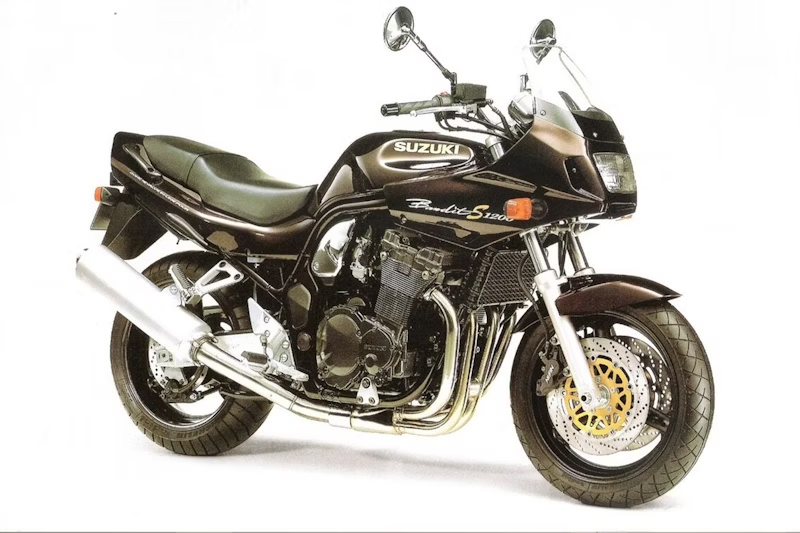
So, what is it? Good question. I’ve been working on that for some time now and I think I finally may have an answer. To use a favourite description of mine, the Bandit 1200 is a stupid bike. Now, before you all start writing “Dear Sir, in the September 1996 issue of Two Wheels, I was disgusted to read…” letters and Suzuki Australia gets its QC on the hotline, allow me to elaborate.
When I say stupid bike, I do not – repeat, do not — mean that the Bandit 1200 is in any way trivial, silly or frivolous. Nor is it lacking in normal intelligence or common sense. It isn’t even — if such traits can be attributed to a motorcycle — stunned or dazed. Nothing of the sort.
The bike is very good. Great, even. It just has an amazing knack of causing its rider to do amazingly stupid things — hence the description above. It makes you do silly things. Socially unacceptable things. Bloody huge fun things. And you have absolutely no say in the matter.
In my couple of weeks with the Bandit 1200, I found myself attempting all manner of immature and reprehensible acts — the kind of acts that really get up the nose of polite society and give all motorcyclists a bad name.
Acts like screaming away from traffic lights at full noise with the front wheel pawing the sky; like ripping off a huge, smoky burnout in the car park of my local shopping centre during one of its busiest times — with a friend on the back; like popping wheelies up and down my street, outside friends’ houses, outside local schools (trust me, the kids love it!) and anywhere else I could get away with it.
It’s all stupid stuff, and certainly not the type of thing a supposedly responsible and mature motorcycle journalist should be doing. But I didn’t give a toss then, and I still don’t now. For those two weeks I wore a grin from ear to ear.
Central to all these antics, and the Bandit itself, is the GSX-R1100 (the last of the oil-cooled GSX-Rs) sourced engine. This great lump of a mill dominates nearly every view of the bike and provides all those lovely horsepowery things that make riding the Bandit such a hoot.
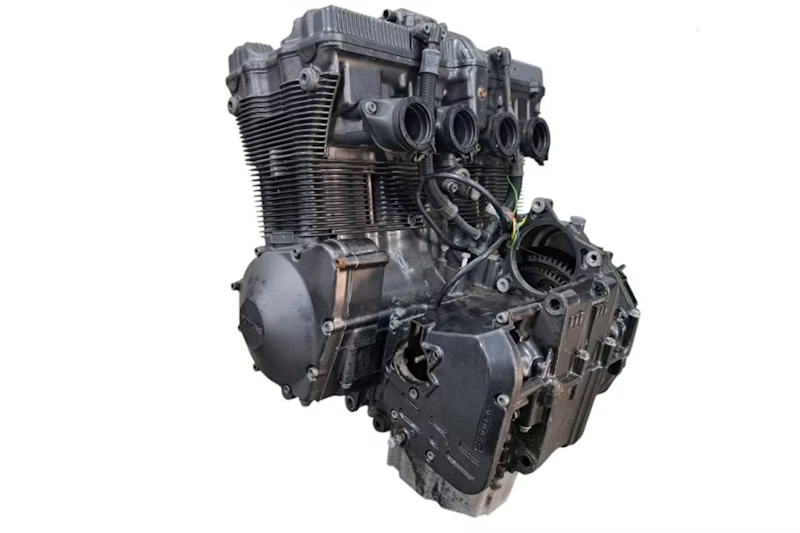
It’s also the reason why the Bandit has so much delinquent appeal in comparison to other big bore naked bikes on the market. Unlike Honda, which chose a sports-touring motor (from the CBR1000) for its CB1000, or Yamaha, which used the touring-biased FJ1200 mill for the XJR1200, Suzuki did the right thing and went for a full-on sports bike powerplant, albeit a detuned and otherwise modified one.
And what are those mods? The bore has been taken out by 1 mm to 79mm (stroke is the same at 59mm) giving a displacement of 1156cc. The compression ratio has been lowered from the GSX-R’s 10:1 to 9.5:1. Cam timing has been altered and the valve adjustment system is also different — the Bandit uses a screw and locknut system as opposed to the GSX-R’s shim method.
Lastly, the Bandit receives its fuel via a bank of four 36mm Mikuni BSTSS carburettors with a throttle position sensor. The GSX-R used 40mm Mikunis and no sensor. The airbox is 600cc smaller on the Bandit at six litres, while exhaust gases exit through a four-into-one stainless steel header system with a large volume aluminium muffler.
One look at the dyno chart will tell you all you need to know about the Bandit’s power delivery. The action begins at about 2300rpm, and apart from a small dip at 2800rpm, it continues smoothly and virtually seamlessly all the way to 8800rpm – no pips, no lumps, no bumps. Peak power as measured at the rear wheel is smack-bang on 73kW — not huge when you line it up against 85kW ZX-7Rs and the like, but it’s utterly accessible nonetheless.

The torque curve is similarly enlightening. Our example stopped the clock with a peak reading of 96.2Nm at 3800rpm, but from that point until 7200rpm, the level of torque produced by the Bandit’s engine varies by no more than 4Nm. Impressive.
What all this translates to is grunt. Instant grunt. Grunt to cream the tin tops off at the lights, to make that gap in the traffic, to avoid a potentially disastrous situation just ahead.
But you don’t need to be mixing it with the peak-hour gumbies to appreciate it. The Bandit is particularly rewarding on a nice bendy stretch of backroad, using only the very responsive throttle to control your progress as you go swingin’ down the lane.
There is a substantial amount of vibration from the in-line four, felt mostly through the ‘bars and the seat, and although it was most prevalent in the 100-130km/h range, I never found it annoying. Others who rode our test bike thought differently, but I believe the Bandit 600 is actually the more vibey of the pair.
The five-speed constant-mesh gearbox is a peach, offering typical Suzuki slickness and precision for every shift. In sports mode, if you’re so inclined, it’ll let you perform the hot-shoe shuffle on the gear lever with neither complaint nor missed shift, but with a motor as flexible as the Bandit’s, there really is no need.

Where it does shine is around town, where every light prod on the lever is rewarded with an almost imperceptible ‘snick’ from the gearbox and a barely noticeable dip of the tachometer needle. Seriously, who needs expensive quickshifters when Suzuki mass-produces transmissions of this standard?
Having a sweet motor is all very well, but one does need a suitable chassis to house it all in. In the Bandit’s case, Suzuki has opted for a hefty-gauge steel tube double cradle frame welded to pressed steel side-plates, with a chunky aluminium swingarm.
Hanging off the front is a set of 43mm conventional forks with screw-type spring preload adjusters at the top of the slider tubes, while the rear is suspended by a single gas and oil-damped shock, actuated via linkage and with adjustment facilities for spring preload and rebound damping.
Braking is courtesy of a pair of 310mm discs and four-piston Nissin calipers at the front and a single 240mm disc and two-piston opposed caliper rearwards. Three -spoke 17-inch alloy wheels keep it rolling. These are shod with 120/70 and 180/55 rubber, in our case Bridgestone BT54 front and BT54 rear.
Apart from the tyres, which are too hard and give insufficient grip for a bike that will probably spend its life having its backside thrashed, the 1200’s chassis package works well.

The Bandit’s ride position is a good ‘un, although the seat height (835mm) may prove a pain for shorter pilots. The one-piece seat unit is broad and well-padded for the rider and cants your body slightly forward, making the reach to the ‘bars an easy one. This is good for controlling the bike, but I found the seat sloped and tapered a little too much towards the tank, pushing my hips forward and my goolies into hard steel. You can shift yourself back slightly to ease the pressure, but you automatically slide forward again every time the brakes are applied.
This was most noticeable around town, especially in the kind of stop-start traffic I deal with every morning and afternoon, but was a less of a problem out on the highway.
At 214kg dry, the Bandit has a substantial weight advantage over Honda’s 235kg CB1000 and the 233kg Yamaha XJR1200, and this pays dividends both in ease of use and manoeuvrability. It’s certainly no chore to punt the Bandit through traffic and about the only time you realise it’s a 200kg-plus beast is when you have to wheel it in or out of the garage.
The suspension coped well with just about everything I was able to throw at it, although it wasn’t too hard to get the rear end to wallow through faster corners. I was particularly impressed with the forks, which offered good compliance and a respectable amount of damping even in the sticky stuff. They also exhibited none of the sogginess of those fitted to the Bandit 600 and I didn’t find it necessary to alter the preload from its standard setting.

On a Sunday morning run up down the twisty and bumpy road from Central Mangrove through Spencer and Gunderman to Wisemans Ferry, and then along the Old Northern Road through Sydney’s semi-rural outer north-western suburbs, the Bandit 1200 was a delight.
With my good wife along for company, I’d upped the rear preload to compensate for the extra body on board but made no other changes to the bike. There was no need. The big Suzuki was sure and stable through even the bumpiest sections, while the wide bars and easy flow of power made bend-swinging a simple matter of point and squirt.
Some of the tighter corners required a fair bit of muscle to get the bike set up and turned, but for the most part it was a relaxing and low-effort run. Unlike the Bandit 600, the 1200’s footpegs stay clear of the deck and you can hook in with gusto.
Under brakes, the 1200 also behaved itself, slowing rapidly and predictably with a minimum of effort (two fingers) and excellent feel from the front stoppers. The rear gave a little less feel but was adequate all the same.
Mrs C. gave the Bandit’s pillion accommodation a tentative thumbs-up, praising the side-mounted grabrails and broad seat but expressing reservations about its excessive firmness and the implications that would have for a longer journey.

Like its smaller sibling, the Bandit 1200 comes standard with a frame-mounted half-fairing, a feature I expressed thanks for more than once. Apart from providing some measure of weather protection, the fairing is a boon on longer hauls, directing wind blast on to your chest and enabling a higher cruising speed with reduced fatigue.
Speaking of high cruising speeds, the luggage facilities on the Bandit include ocky strap hooks (two on each side below the sidecovers) and a number of alternative strapping points. My magnetic tankbag sat nice and securely on the Bandit’s tank. Most other types should too.
I had no complaints about the ancillary equipment fitted to the Bandit. The front brake lever is adjustable for reach, the instruments are very legible, there’s a fuel gauge that works, and the action of the controls, particularly the hydraulic clutch, is light.
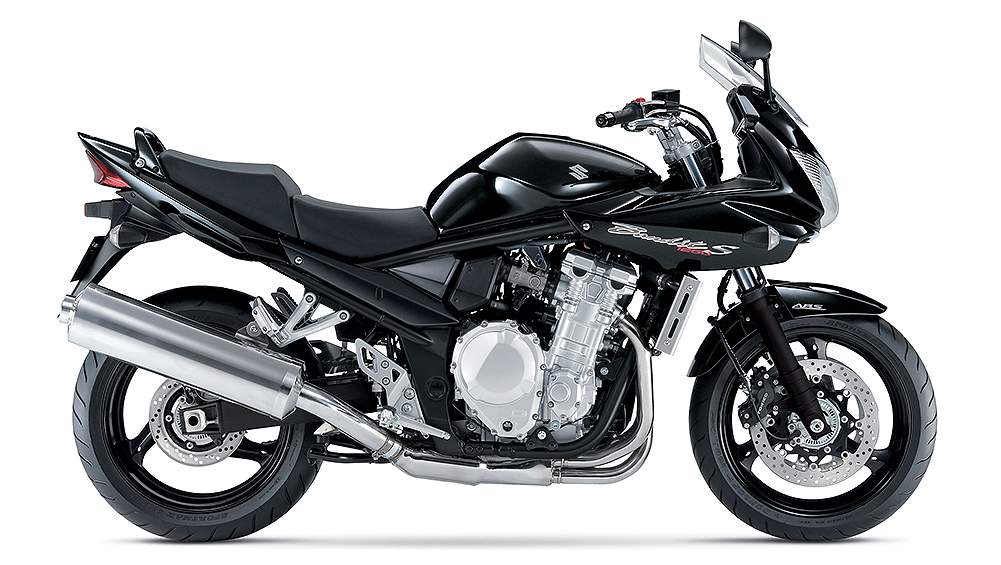
Styling is always a subjective area, but for what it’s worth, I thought the 1200 looked pretty neat. There are plenty of curves, especially in the sculpted fuel tank with its dished hand indents, and the rear sidecover/ducktail, which reminded me of the RF900’s similarly-styled but much broader unit.
From the side and front three-quarter angles, the Bandit looks mean and purposeful, especially in the Pearl Novelty Black paint scheme of our test bike. From the rear, it’s equally businesslike, with the fat rear tyre and large exhaust can dominating the view.
The finish on our test example was of a high standard, as was the build quality and componentry. But perhaps the most attractive feature of the Bandit 1200 is the price: $11,899 plus on road costs. For mine, it’s a bargain. Overall, the Bandit is a better motorcycle than either the Honda or Yamaha and the low retail whack ($2000 cheaper than the XJR and $1713 less than the CB1000) is simply the icing on the cake.
By Pete Callaghan, Two Wheels, September 1996.

The Big Easy
The biggest stock market crash since the Great Depression (the 2008 GFC — Ed) has done a few things. It has proved once again that pyramid schemes are alive and well, and refocussed people’s attention on tangible things that represent good value. It is on that second point where the new naked GSF1250 Bandit really shines, and not just because of its reasonable price, but because it does so much, so well, and with such subversive hilarity.
My first impressions were how apparent the bike’s 247kg kerb weight felt after stepping off my Ducati Monster, and the confused styling of a digital speedo within a chromed circular dial. It had me wondering if the Bandit was going to miss the mark.
But I should not have worried. Two weeks and 700-odd kilometres later, the Bandit showed me that Suzuki had, in fact, hit the bullseye.
There is no getting past it being a big bike, and to get the best out of it you must take it by the scruff of the neck and show it who is boss. Then, like that giant wave of torque being produced by the engine, good feelings just wash over you and make you want to love it forever.
Those of you who remember the first 1200 Bandit will find the styling familiar, right down to the Metallic Cherry Red paint, the only colour available in Australia. However, in a departure from the first versions, the frame is now painted black, so if the Metallic Cherry Red is not to your liking you could easily have the tank and side panels painted another colour. This also means that the rest of the motorcycling world will be spared that uniquely Bandit phenomenon of arse-about custom streetfighters with black fuel tanks and coloured frames.

Once you have become accustomed to the weight, you can’t help but revel in the torque and flexibility the engine offers. At 30km/h in sixth gear the 1250 is doing less than 1000rpm; in fact it is revving lower than its idle speed. Yet it will still pull away smoothly without throttle snatch or hiccups right through to the redline.
This immense tractability is something quite special and makes the Bandit a very forgiving and flexible bike to ride, both in the stop and start of commuting as well as scratching through the hills. Clearly there is something in Suzuki’s claims that its Dual Valve Throttle (SDVT) fuel-injection system “provides better throttle response” and a “smoother power output.”
The bike is also fitted with a pulsed air-injection system and an oxygen sensor to minimise emissions, although judging by the size of the muffler I am surprised anything ever escapes its grasp, let alone emissions.
The 1250cc engine is not a monster in outright horsepower figures when compared to modern 1000cc superbikes. It makes the same 73kW as the earlier oil-cooled 1200 Bandit, but it produces a massive 108Nm of torque at just 3700rpm, and just as Tassie kilometres seem to be longer than mainland kilometres, so 1250 Bandit horses seem bigger than the rest.

You can drive through corner after corner and make rapid progress without thinking about what gear you are in, or you can raise your heartbeat and confuse sportsbike riders by riding in the upper reaches of the rev range, spinning up the rear exiting the bends with the front pawing the air. The choice is yours and the Bandit is perfectly comfortable with either.
Importantly for the GSF 1250, these are the same qualities that made the first model such a great bike and so deserving of its cult status.
Unlike the earlier 1200, the 1250 is a very smooth engine at cruising speeds with just a hint of harshness at the top of the rev range, so it lacks that rough edge many found enticing in the 1200 Bandit. For some that raw edge made that machine feel like the bad boys’ bike it was to become, while the new 1250 with its smooth engine and sophisticated feel had me worried the Bandit might have lost its charm.
It is a much more refined bike, a product of ever more stringent emissions and noise regulations, but it still has a hidden hooligan element just waiting to be let out. The big trick is not to get caught indulging it, because it wants to come out quite often, and society looks down on people having fun. The huge grunt means it will loft the front wheel easily and tear its tyre to shreds at your command, all the while being easy to control from its sensible perch.
How much hooligan you let out will determine what sort of fuel economy you achieve. My average was about 7.6 litres per 100km, with sports riding returning about 8 litres per 100km. Speed-limit freeway work will dramatically improve this figure to the mid-fives, as 110km/h has the engine spinning just below 3500rpm in top gear, and as this is only a few hundred revs short of peak torque, effortless overtaking is a mere twist of the wrist away. It makes for relaxing, secure touring. The 19-litre tank will give a useful range of at least 240km, stretching to more than 300km if you are sensible.

The Bandit’s handling is safe and competent, but not at the level of a modern sportsbike. Both the weight and basic suspension can combine to produce some squirrelly feelings when accelerating and braking hard. On bumpy backroads the suspension can seem undersprung, with the occasional gentle weave as the bike pitches over bumps. It’s something riders of heavy Japanese bikes would be familiar with, but if you have only ever ridden GSX-Rs, you will be surprised.
The softness of the suspension is also noticeable on initial turn-in at speed, when the bike feels slightly twitchy, but once into the turn it is stable and confidence-inspiring. I expect this movement is something that could be sorted easily with different tyres or some suspension adjustment, and the 43mm conventional forks should give scope for improvement.
The standard suspension is adjustable for spring preload at both ends. The front fork adjusters are on the top of the fork legs, while the rear is a collar above the spring. It’s not much, but should allow those travelling two-up or carrying gear to better set the bike up.
When pushing on with the Bandit, you have to push your weight over the front end to get the best out of it, but once you’re up front and assertive it does things that just shouldn’t be possible on a 250kg bike. Changes of direction are easier, too, once you start to push and pull on the handlebars. After one 15km stretch of tight comers, I was breathing hard from the physical effort involved. l was also grinning madly and feeling very satisfied with the 1250’s performance.

The Dunlop D218 Sportmax tyres hang on bravely, but the rear spins up a bit too easily in the dry exiting comers. It wasn’t producing big slides, more a case of rapidly rising engine revs without the corresponding rise in forward motion. The tyres also don’t provide huge amounts of confidence in the wet, feeling somewhat skittish and loose on damp surfaces. I wouldn’t be overly concerned, though — if you ride the Bandit hard you won’t see much beyond 1500km out of the rear tyre anyway, so you will get to change it soon enough.
The large size of the GSF1250 means that it has great ergonomics for people who are reasonably tall, and by tall I mean about 180cm. The space means you can shift around on the seat depending on what you are doing — nice and forward for the twisties; back and relaxed on the freeway. The handlebars are angled back slightly, which feels odd at first but makes sense in the hills, while they are also not too wide, allowing for easy lane filtering.
When you’re braking hard on the Bandit, there’s the ever-present sensation of a large mass being stopped against its will. The four-piston calipers might not have the street cred of the current crop of radial-mount jobs, but they do work — although a good squeeze must be called on occasionally.
Importantly, Suzuki offers an ABS option for $500 and, while it is not switchable, it is a great safety enhancement for the vast majority of riders, especially those who use their bikes daily in all weathers. The test bike wasn’t fitted with ABS, but if it were going to be mine I would take up the option.
During the test I picked up a nail in the rear tyre and had to repair it at home. The standard fitment centrestand meant l could easily find the nail, remove it and repair the puncture without having to resort to race stands or jacks. It was also a reminder to always carry a simple tubeless repair kit, as on the GSF1250 it would have been just as simple to fix the flat on the side of the road.
The practicality doesn’t stop there, with the large circular headlight providing excellent light with good spread and depth, while the instrumentation is also clear and easy to read day or night. Bungee hooks are located under the tailpiece and even the seat is height-adjustable.

There’s room for tweaks as well. Those wanting to use the bike as the basis for a project and increase the engine performance can expect significant gains (to 90+kW) from relatively simple modifications such as a Power Commander and an aftermarket exhaust.
The Bandit is built to a price and that’s evident in the lower spec suspension components and steel frame yet, apart from a few messy wires to the horn, the finish is excellent.
As such the naked GSF1250 Bandit remains true to its original concept. At $11,490 or $11,990 with ABS, it is easy to buy, easy on the eye, easy to modify, easy to ride fast, easy to ride in gridlock, easy to maintain, easy to tour on and easy to indulge a track day on. It is possibly the best value big bike on the market and in these times of financial prudence it makes even more sense than ever.
By Alec Simpson, Two Wheels, January 2009

Snag from InfoMoto reckons that, as a used bike, the Suzuki Bandit might just be be “the best bang for your buck buy on the planet?” You can read his assessment here.
A quick look at the 1200/1250 Bandits on bikesales.com.au (in December 2025) is pretty tempting, and confirmation that Snag is on the money.