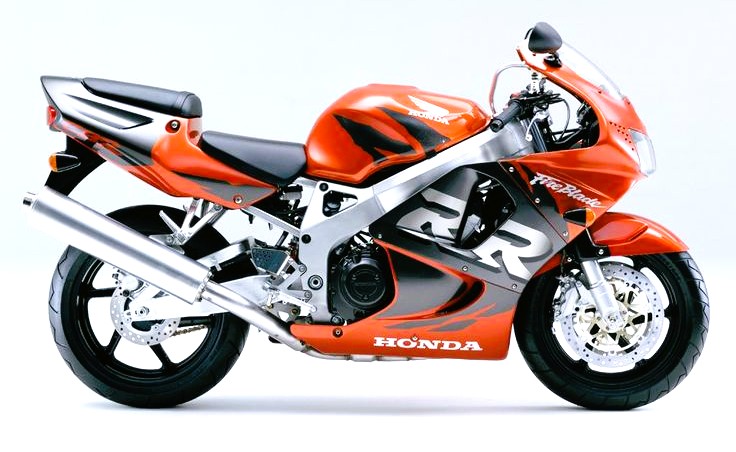
Honda CBR900RRW FireBlade 1998-2000
Phillip Island, 1992: the international debut of the FireBlade and Honda has hit the spot. All other sports bikes pale in comparison. Everything that came before is history; all that lies ahead is going to have to be phenomenal to kick this thing’s arse.
Phillip Island, six years later: the national debut of the fourth generation ‘Blade. Not quite the bells-and-whistles affair of ’92; that has happened in some other, more exotic corner of the world. And it’s obvious that the latest lairy weapon from Honda is now facing other, more exotic competition.
Some of the other manufacturers have — at long bloody last, and after a few false starts — caught on to the ‘Blade’s secrets and conjured up some real contenders for its title.
But six years is a big head start, and Honda has plundered the time for all it’s worth, honing the ‘Blade to its sharpest and, more importantly, most flawless edge yet.
Weight savings bring it down to just 180kg; power tweaks bring it up to 95.5kW. Not only this, but the ‘Blade feels better too – lighter, faster, quicker steering, more accurate. Much better.
And it’d want to, with the new Kawasaki ZX-9R and Yamaha YZF-R1 ready to knock the stuffing out of anything that shows just a hint of weakness.

Straddle a 1998 FireBlade and it feels bigger than before because the upper fairing is broader and longer. It gives marginally better protection from high-speed wind blast and puts a more aggressive face on the bike, but it is still a minimalist sports fairing and you feel it when you poke your head out from behind it into a 260km/h gale. The back end, too, is wider for smoother aerodynamic flow. You probably won’t notice the few millimetres’ difference in handlebar and footpeg placements.
What is very clear, if you get a chance to ride the new bike back-to-back with a 1997 model, is the more agile handling for 1998. The new bike flits into corners with a feline ease that tempts you to commit harder and takes you to the edge of the rear tyre all too soon. One of the first things I’d do, at least for racetrack fangs, is get rid of the ridiculously long extensions on the footpegs, which grind with monotonous regularity.

Through the apex, the 1998 model is more firmly rooted to the tar and feedback is improved. It lets you change line, or roll the throttle on or off, with more confidence than ever. And it willingly holds a tight line on the way out of a bend, great on a narrow country road where margins for error are slim.
Smart refinement is the only single factor you can pin on the improvement. The same Bridgestone Battlax BT56 tyres come with the ‘Blade this year, so all the improvements come down to the suspension and chassis revisions.
The only major chassis change is that the steering head has been moved forward 5.5mm, fork offset brought back 5mm and, as a result, the bike’s trail is 5mm longer. Trail is the critical dimension affecting a bike’s front-end stability and rate of steering. Theoretically, an increase in trail should slow steering, but Honda’s engineers have managed to counter this effect with other changes, so the ‘Blade gets the benefit of added stability (and it is wonderfully stable) without, apparently, any drawbacks.

Revised suspension rates and components have also helped markedly. Suspension was criticised on the first two ‘Blades, but this one is very good. The last model’s was on the mark, but now there is much more feedback from both ends and a relative plushness on public roads that doesn’t turn to mushiness when you want serious performance. The rear suspension’s ratios are revised to work over a wider range — a more compliant initial rate which firms up to the same degree as the 1996-1997 model. The ‘Blade takes a minimum of fiddling with the adjustments to get it right between the track and the road.
Suspension movement over bumps is among the best you’ll get and, even in a corner, it takes a close-set series of bumps to do more than make the ‘Blade skip a beat. Phillip Island has a nasty lump across the track just before you’re fully tilted into the rise to Lukey Heights, and charging the ‘Blade straight over it simply means having the whole bike jump and then come down safely — with the footpeg riding the tarmac.

Corrugations mid-way through a country corner, again with the footpegs scraping, send both ends juddering sideways, but the angle of attack isn’t altered and, provided the corrugations end in time, the Honda keeps tracking around when it regains grip. This reaction is a good sign of a balanced bike that doesn’t push excessively hard at the front.
The forks are held 10mm further apart, which Honda says adds 10 per cent more torsional rigidity. The new tapered swingarm is said to give an “optimal balance of rigidity” but what this actually means is anyone’s guess. Honda does claim the swing-arm contributes to the lighter feel of the new ‘Blade.
For all the stiffness, control and feedback in the front end, it is still not quite a match for what Kawasaki has achieved over the past few years, starting with its 1991 ZXR750.
New calipers on the front wheel, still from Nissin, with 310mm rotors instead of the previous 296mm ones, raise stopping power another notch. They take a bigger first bite out of your speed and feel consistent all the way from first squeeze to final stop. But again, like the front end, the Blade’s brakes still lack the leading edge held by some of its opposition. The margins are slim, but the difference noticeable.

Ninety-four kilowatts is a fair whack in the seat of the pants from anything on the lighter side of a quarter of a tonne. Bang up another gear at full noise, at the same time as you’re cranking the ‘Blade from one side to the other, and a spasm jolts through the chassis which twists the rear end in a soggy-feeling wallow. That’s the only bad reaction from the chassis to the power in the package, and it is not uncommon on any megabike. The other reaction comes from the rear tyre — a desperate plea to go easy and spare its life.
The Bridgestones aren’t the last word in grip, but they last reasonably well and, when they do reach the end of either their tread or their ability to go any harder, they slide predictably. The combination of the rear tyre’s feedback and the lovely feel through the chassis gives confidence to push it to the limit. The front, like before, never runs to the edge of the tread and hangs on very well.
The 1998 engine is not as big a step forward as the chassis, but the gains are there to be seen. The dip in the lower mid-range common to most stock bikes has been reduced to a mere sag between about 5000 and 6000rpm that is hardly noticeable on the road. From 6000 it’s a pretty straight climb to the peak at 94kW, with slightly more power all the way compared with the 1996-1997 model — maybe one or two kilowatts average. Anywhere above 8000rpm is hot stuff.

Honda uses the power gains to carry taller gearing for fourth, fifth and sixth gears, potentially increasing top speed. This test hasn’t allowed us the chance to see what she’ll do, but maybe next time …
Eighty per cent of the engine’s internals have been modified for 1998 to get this extra power and to control heat and friction. Combustion chambers and intake and exhaust ports are refined, always good places to start. Composite cylinder sleeves — like the ones in the RC45 made of aluminium, ceramics and graphite — save more than half a kilo in weight and dissipate heat better. A solid lubricant on the pistons helps reduce friction. There are cooling system alterations, including the addition of another row to the radiator core which is claimed to increase cooling capacity by seven per cent. The exhaust pipes are now all stainless steel; and the alloy muffler is slightly longer, five per cent more voluminous and a fraction lighter than before. The ignition map was reprogrammed to suit the engine changes.
The clutch runs eight, instead of 10, friction plates made from a new material which is claimed to maintain the strength of the old one. It works fine. The gearbox is just the same in its action — usually precise and not heavy. But it does what every other ‘Blade has done on test, and that’s sometimes find a false neutral going down between third and second when ridden hard. Yes, I’m sure a lazy left foot has something to do with it, but these things are much more rare on other bikes.

There’s little else to add about the new bike. It has a new instrument pod, an all-electronic one that is just 28mm thick and includes LED read-outs for engine temperature and for the odo and dual trip meters. The reflector headlights have a little more penetration than before. You will still find fold-out tie-down hooks, good storage and a Scotchbrite for polishing the muffler all under the pillion seat. The familiar splay-legged riding position and firm, flat seat are all there; I hate it around town because my balls always get squeezed into the corner where the tank meets the seat. And like most fours, it will numb your throttle hand on long cruises in the revs that correspond perfectly with legal highway speeds.
Another familiar thing is the $16,000 price tag. It’s actually up $90 to $15,990 to be exact, but whether the sick Aussie dollar lets it stay this way for long is another matter. Honda MPE is ecstatic about being able to keep the introductory price basically the same as last year’s, yet offer a markedly better bike for the money.
The 1998 FireBlade will turn quicker lap times and handle Australian roads more confidently. Riding it is even easier and more inspiring. It is now heaps closer to mimicking the 600s its weight matches but its bulk has never come near.
So let loose the competition. The CBR900RR is as ready as it will ever be.
By Mick Matheson, Two Wheels, March 1998

Guido from AllMoto has done a comprehensive rundown on the first generation 1992 ‘Blade, and its status as a future collectable, here. Mick Matho also tested the first generation model, plus the 1994 second generation, which we combined into a Classic Two Wheels special feature a while back. Read it here.
Guido notes in his ‘Blade feature that many were thrashed and trashed by understandably enthusiastic owners during their heyday, a comment that’s confirmed by the relatively small number that have survived intact and are now offered here at bikesales.com.au.