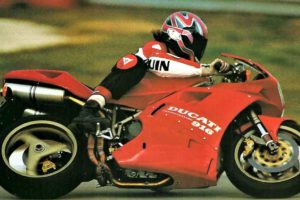

Ducati 900SD Darmah 1977-1982
If you accept that riding in freak rainstorms can provide enough information with which to formulate an opinion, and if you can overlook the hoary old shaft-drive versus chain-drive controversy, and if you ignore the fact that I hated the ride because of the foul weather then, perhaps, you might believe me when I say the Ducati Darmah is probably the best roadster in production anywhere in the world today, regardless of price.
“Nah,” you say. “Italian bikes might have the heart and soul of an angel; but the damn things hide them under the character of the Devil himself — too nasty round the edges.”
Many years ago when Laverda first exported its 750 GT, and before they were even called American Eagles in the US, I experienced my very first quality modern motorcycle. On a ride from the west of England to Venice and back, the perception dawned that here was a bike that not only took whatever I demanded of it, but also came back for more, wanting it all the time. I will freely admit that an R69S Beemer was undoubtedly a more civilised motorcycle, but the Laverda, rudely and gladly, would show one as nimble a pair of heels as a man could then have wished for.
Slowly, but with gathering momentum, change wrought new traditions among the bike makers and bike buyers of the world, these being largely that while the Japanese made super-smoothies full of glamour and durability, the Italians provided machismo for the speed buffs willing to accept their dismal fringe benefits.
Only Laverda tried hard — and eventually succeeded — to break away from that image, but vertical twins are vertical twins however you say it and the 3C triple was a monster needing the fist of a bold old buff to cuff it fast along a curving road. Ducati and Guzzi, with their lighter V-twins, were somehow much more Italian. It seemed Italy might after all lose the marketing battle, for Japan was trying hard in the high speed stability stakes. They were winning, too.
The improved 860 GTL gave us the first hint of what might be coming out of Ducati’s reorganised Bologna factory. It had improved switchgear, although whatever good work it did was immediately foiled by the scruffily-finished 500 Desmo.

The Darmah (it takes its name from the character of an heroic tiger in an Italian folk story similar, no doubt, to Kipling’s Sheer Kahn of the Mowgli stories) was announced in Britain as being an amalgam of 900 SS engine and GTL frame parts, and most of us fully expected something typically Ducati. No-one was anticipating the quality so plainly incorporated into the Darmah.
Because it’s from Ducati you assume it’s going to move well, but the shock comes when you go in for closer inspection and you see smooth paintwork without the slightest hint of orange peel pimpling. The chrome looks better too, without the scratchy, grey appearance common on some Italian machines. Then you notice the big Bosch quartz halogen headlamp and the Nippon Denso instruments and switchgear. Cast wheels by Campagnolo. A prop stand, too. Then you learn about the new transistorised Bosch ignition system. You put it all together with the usual Ducati adoption of the best around, such as a set of nicely rusted Brembo discs, Marzocchi suspension and a trusty set of Michelin boots and you reel back, wondering about the ultimate performance of the thing if it all harmonises into a package as well as you think it should.
It does. Oh yeah, and how it does. Glistening with the warm, icy appeal of an early Zl, finished like an old BMW, purposeful as a Velo’ Thruxton. The more you know about motorcycles the more it impresses. After all that I noticed the low seat and the painstakingly positioned footrests just behind a vertical line from the seat nose and how naturally they balanced with the short, near flat handlebar. The whole thing was right, exactly, beautifully, correctly balanced into a single, flowing movement that spelled perfection.
What Ducati has done with the Darmah is to maintain its current lead of dynamics, equal the Japanese with their trim perfection and match BMW anatomics. It’s given Ducati a lead over all other bike makers. To ride, it’s even better. Thanks to the new ignition system and the re-geared starter motor (carried over from the new GTL), firing up is a cinch, whatever the weather. There is a kick starter for emergencies and believers of the old school, but the thing is sited in such an inconvenient position only blind Ducati fanatics could ever actually admire it.

As the engine is a blood relation of the unfettered 900 SS it might be assumed the Darmah also would be of that type. Not at all. There remains that uniquely indolent power style in which each combustion stroke can be sensed, yet without the aggravating vibration accompanying most twins. It provides a rider with immensely sensual motorcycling. That’s the same as ever. Press the starter and the comforting, familiar, confident “rubba-dubba” V-twinning voice issues from the pipes, undertoned by the excited (and exciting) chatter of oily mechanisms deep inside. No effete hushed rustling of myriad steel complexities such as whisper sly and ashamed from the fat bellies of Jap fours here, but the challenging appeal of truth.
The wonder of it all is that you cannot see the valve train dancing, or the flywheels spinning, as you might expect. It sounds as though you should, as though it would be entirely proper to probe the long spout of an old oil can into the cam boxes and dribble lubricant carefully in all the right places. Probably the reason for all this suggestion of vintage appeal lies in the power unit alone.
Some motorcycles have mere motors — as best exemplified by Suzuki’s “kettle”, Kawa’s big four and suchlike. Others boast engines and, believe me, there is a great gulf between the two. These run as low down the capacity scale as the little MZ 250s and travel up to things like the Jota and Darmah. Whereas a motor is simply the means of imparting motion by whatever means you care to nominate to whatever vehicle you care to name, an engine is the definitive heart of a means of transport being, quite simply, a mechanical contrivance to impart power.
Now then, if you can imagine a large-engined motorcycle encompassing all the traditional, even legendary, attributes of a big V-twin, such as grey-bearded, wild-eyed Vincent owners might have you believe about their particular poison, plus those attributes peculiar to BMWs, then you have a machine that must rank currently as the finest made for road work. The Darmah is exactly that. Without losing any of the marque’s fiery Italian charm it also provides sophistication of a type previously unavailable from Italy. So Ducati now takes precedence in the Latin stakes, as well as setting a standard that others, from wherever, are going to find it hard to meet.
We’ll skip the normal technical description because the Darmah contains nothing unusual when compared to its stable mates. The engine is the normal 90 degree V-twin and the frame the usual robust open duplex. In detail, however, there are numerous improvements. As already described, the power unit is from the desmodromic valve 900 SS. At the time of writing it was thought by the concessionaires that valve timing and valve size was identical to the SS, but from the tractability of the Darmah at low speed I’d say a slightly milder set of cams have been used. It is possible that the adoption of 32 mm carburettors, as opposed to the SS’s 40 mm, might be solely responsible for this, but I doubt it. For another thing, silencing is now so efficient that the likelihood of fierce valve timing being of any practical value is pretty remote.

Apart from the improved breathing systems of the engine, there is another first-timer that, probably more than any other single modification, has raised the efficiency of the new Ducati so far. Time was when Bosch electrical equipment was like old BMWs — vastly over-engineered, albeit with a performance quality second to none. As many a luckless early Laverda triple owner will verify, in its search for a balanced combination of production budgeting and component quality, Bosch erred too far in the wrong direction, falling foul of the trap that has more or less shoved Lucas right out of the bike business. Luckily for us Bosch has put enormous effort into developing a new motorcycle electrical system with efficiency once more the keynote. The latest is used on the Darmah. Ignition has never been a strong point of any Ducati, but Bosch has developed a new stepped advance ignition, fully transistorised, of course. Ducati, like Honda, appears to be concentrating on combustion efficiency at all engine speeds but, unlike Honda, which provides a progressively curving ignition advance, Ducati, via Bosch, has opted for a simpler, four-step advance switch.
The pulse generator is built into the main 200W alternator, and takes the form of two pick-ups mounted at 90 degrees in the cover plate. As the magnetic trigger passes them they transmit a signal to one of the pair of transistorised amplifiers. Within these units is also the engine speed-sensitive timing devices, from where on is sent an amplified low tension signal strong enough to energise one of the two HT coils, which provide spark for the plugs. From 900 rpm the ignition advance is a mere nine degrees. This provides gentle and sure-fire starting and regular idling, right up to 1800 rpm. Here the ignition is advanced to 16/18 degrees, where it remains until 2800 rpm, at which point an advance to 28 degrees is made. From there on a progressive advance increase is made up to the optimum combination of 32 degrees at 4000 rpm. It might appear to be somewhat late in the day by most standards, but Ducati and Bosch know their business well. The most amazing tractability is available for Darmah riders. It also allows the use of cheap fuel, as I discovered during an experimental couple of litres of “worst” (88 octane), during the use of which the Darmah behaved impeccably despite deliberate heavy-handedness at low engine speeds.
Admittedly, overall gearing is down by 12 percent when compared to the SS but, even allowing for this, the improvement was remarkable. At a mere 32 km/h in top gear enough acceleration was on hand to make the proposition entirely normal, let alone feasible. Considering the engine was spinning at 1250 rpm — close on the idling speed of some little zappers — it was all the more remarkable.
“OK,” you say. “So Ducati has got itself a bike which at last equals the Z1000. So what’s new?” It’s this. On a lithe and agile sportster Ducati has incorporated qualities equalling the best tourers and exceeding most. The Z1 weighs around 261 kg fully tanked, and has a top speed between 200 and 209 km/h. This speed is by no means as easy to accomplish as you might imagine, thanks to a predeliction for Irish stability.
The Darmah weighs 223 kg, offers equal flexibility and traffic manners and silence, then hands out a bonus of similar top speed which is readily attainable thanks to unmatched stability. Japan, watch out, you have met your match in all but marketing — which will undoubtedly be your ultimate salvation.
Years ago, Bernal Osborn of the old British weekly Motorcycling, praised the Ariel MkII 4G Square Four when he discovered it would pull in top gear from 16 to 164 km/h, giving 148 km/h at 5300 rpm. That kind of performance then was staggering. I wonder how he would have felt aboard the Darmah with its top gear performance of 21 km/h (800 rpm) to an absolute minimum of 193 km/h (7400 rpm).
I must confess I used a velvet glove when attempting the top gear minimum speed, but it was by no means a freak reading. Next confession concerns performance timing. Having had but one day in pouring rain in which to evaluate the machine, the chance to record its speed accurately did not arise. A few attempts to promote decent sprint times provoked vicious wheelspins with consequential camber slides and slow times, and so heavy was the rain that nothing more than 164 km/h was possible. To the maker’s credit more speed was available. Only the rider baulked at the task.

As 164 km/h equates to an engine speed of 7400 rpm, and as the makers advised the top limit of 7800 rpm was still 400 rpm away with the power still pouring out in fine style, it seems reasonable to assume the ultimate top speed under favourable conditions will be something around 202 km/h at least. Two things come to mind at this. First is the accurate overall gearing provided and second is the overmodest claims by the factory of a top speed of “only” 200 km/h.
Frankly I very much doubt that the top speed of a fully run-in, correctly-prepared model will prove to be that low, and if it is then some pretty minor adjustments to breathing are going to be required to boost this silken baby’s running. How else could it be with the SS engine to hand? It goes without saying that cog-chopping was pluperfect, helped no end by the apparent adoption of new clutch plate springs and friction material, or an improved operating mechanism. Clutch action on the test model was seemingly improved over that of the SS and new GTS which I rode recently. Not that it was ever bad, but this felt lighter.
The appearance of the Darmah is different to anything gone before from Ducati, save perhaps the 500 parallel twin, and both are Leo Tartarini-styled. Always good, Ducati has excelled itself with this one. While the appearance of the Darmah might not be to everyone’s taste, there is no denying its anatomical perfection. How long have I been playing the whingeing Pommy because of the ignorance displayed by even the best bike designers about the fundamentals of correct rider positioning? Years, bloody years. And I become so sick of it, sometimes I wonder if it isn’t me that’s wrong. Then a ride on a BMW puts my mind to rest, for a while at least.
But all the time there’s this gnawing suspicion about why all the really big bike makers are generally so dumb about the necessity for comfort if chassis performance is to be fully realised. Having ridden the Darmah I know, beyond all reason of doubt, now and forever, that the whole damn bike-making world really is out of step with me — and a few others besides. That lovely motorcycle contains all I have ever dreamed about good riding.

The saddle is low, at around 737 mm, so a rider can tuck in low and scud round bends like no man on any other big mover can do right now. The handlebar is flat and narrow, so it promotes not only a good riding position, but also a feeling of confidence, for it discourages unwarranted gyroscopic precession and thus positively contributes to stability.
The footrests are mounted semi-rearwards, somewhere between road-racing positioning and normal sports roadster. Given a fleeting intro a man could be forgiven for claiming imagined discomfort because of the unusually rearward-slanted angle of his legs, but given 50 km of fast road he would appreciate the reasoning behind them. Which is not to say they promote discomfort around town, or discourage weekend touring with the bird on pillion, or a quick spot of shopping in town sometimes. Not a bit of it; in fact I am tempted to say that Ducati has now stolen the riding compromise BMW perfected so well, it could not be logically labelled as a compromise any longer. BMW’s was the definitive sports roadster riding position until the Darmah came along, because it’s even better.
I was never conscious of any isolated body area or limb enjoying either extra comfort or discomfort during the day’s ride. Everything fell, as though instinctively, into its own slot so well that it was akin to wearing a pair of slightly undersized road-racing leathers on the road — and you can’t get much better than that for fine road riding. No single limb or joint was isolated; all relaxed and unstressed, whatever the road speed in hand.
Because of this, road speed took on another meaning. What felt fast, even on the 900 GTS, was in this instance easy cruising. Mind you, the improved Nippon Denso instruments added their assistance as well, requiring far less study than the packed Smiths units with their cluttered faces. It all adds up, you see. One apparently insignificant detail after another until the final, corporate product emerges as clean and complete as could be made by man.
How tempting it is to reflect on the suspension, searching for some provable reason for its uprated performance. I mean, it just has to be uprated because it feels as though it is. Only it’s not. Admittedly, it’s some of Marzocchi’s top drawer equipment, back and front, but it only seems to operate more efficiently because it has less to do because the rider is blended into the machine so ably. Objectively it lies part way between the soft luxury of the GTS and the firm resilience of the SS. For the Darmah, it’s perfect.
The same applies to braking, thanks to Brembo’s refusal to conform to stainless steel idolatry — perpetuated by the refusal of certain leading American journals who should know better to face the fact of wet weather braking. One of the standing jokes in Europe right now is Suzuki’s blandly labelled information on their lower tele-leg to the effect that their brakes don’t work in wet weather! God help us all, what is happening to Suzuki’s sense of values?
Rusty the Darmah’s big Brembos are, but also safe and comforting in bad conditions. Better even than old-style drums when the chips are really down. And as for dry weather power, well it all depends on your neck and that’s all there is to it. The harder you squeeze the more quickly you stop, yet at low speeds there is all the gentleness you could wish for.
But back to rider positioning. Everything harmonised nicely so that no one thing dominated, although the single exception could well have been the low height of the seat. At 737 mm, and despite the lean stance of the Darmah, it nevertheless created the impression of providing a sit-in positioning, rather than a sit-on one, rear set footrests, flat handlebar or not. The effect on performance was akin to that provided by the Moto Guzzi 750 S3, only more so. Line changing became so blessedly simple its delights finally overwhelmed all other aspects of riding until it proved difficult not to line chop, even in situations where it wasn’t needed.

That was good, but the narrow, firm tailoring of the padding wasn’t. Time was when the Italians made about the best dual seats around, preferring the support of a skeletal frame, mattress type springs, and two centimetres of extremely firm rubber on the top to the modish, but incorrect, styling of today. In what appears to be an attempt to blend the two distinctive types, Ducati has arrived, as so frequently happens in these cases, at a unit displaying the worst, not the best, of both. The seat is too narrow and too firm, so I found myself not far short of balancing across it, endeavouring to keep the cheeks of my backside from sliding down either edge.
The lighting system, as might be imagined coming from Bosch, is the best standard type around, identical to BMW and Laverda. So is the horn, although this is a Fiamm unit with all its loud quality.
A name that has been “lost” to us outside Italy for some time now is Campagnolo. Okay, so it reigns supreme in cycling, but remember the old 600 cm3 MV Agusta roadster four of the mid-’60s and its cable-operated duplex Campagnolo disc brake up front? Not much of a stopper at all, but the same factory is now back into bikes with a vengeance, and turning out some of the best looking cast wheels around. The Darmah uses them in preference to the 500’s Guzzi type, which do leave something to be desired. The Darmah’s are obviously die cast and have a durable bronze finish, so you can kid all your mates you ‘re riding around on mag-alloys, not mere aluminium, which they actually are, of course.
Switchgear is normal Nippon Denso and very nice too.
And that is the Darmah. It’s not the fastest bike around, but it lives in the top straight-line bracket for all that, and for any road with a few curves, it’s without peer.
If BMW decided to step out of its traditions and engaged Enzo Ferrari to build a top-grade roadster, then this is the kind of machine that would result from the partnership. It’s that good, believe me.
By Dave Minton, Two Wheels, February 1978.

It’s the Worst Bike in the World
Tugging at my beard as I wipe a tear from my jaundiced eye, I would like to say that the Duke 900 Darmah is a terrible bike. Never, in 19 years of riding, has a machine left me feeling so annoyed and upset. The Darmah is one of the worst bikes in the world today and I’ll list the reasons.
One: It is hopeless in traffic because cars keep getting in the way.
Two: It arouses in the rider a stream of passions which cannot be satisfied by less than two hours in the saddle.
Three: It will break up families, drive sons from the warmth of a mother’s breast and husbands from their family.
Four: It cannot be used for short-haul journeys. A rider setting out for a packet of fags from the corner store may well end up in Queensland, or Perth, or anywhere.
Five: The clunky gearchange doesn’t improve until the machine is travelling quickly enough to make life enjoyable.
Six: I can’t afford to buy one.
A day at Amaroo riding the CBX, the Duke and the Project Thumper 350 was an attractive proposition, especially as I hadn’t ridden the Darmah. A series of unfortunate timing incidents meant that I was always where the Darmah wasn’t and vice versa.
After a few laps on the Thumper to refresh my memory of lines and speeds at Amaroo and a few laps on a CBX to remind me of the real meaning of fear, I approached the Darmah cautiously. It had been circulating much more slowly than the CBXs, or so it seemed, and I thought it would be like the usual Duke, relaxed and slow.
The first thing I noticed was a few of the old Duke features like rusty exhaust pipe clamps, rusty Allen screws on the handlebar clamps, blue exhaust pipe headers — a wealth of small imperfections that shows the Duke is a rider’s (engineer’s) machine, not just a pretty face with cosmetic compromises.
A pleasant surprise is the Japanese-style switchgear which looks as though it comes from a CB250, circa 1973. A whole lot better than the intermittent circuit breakers fitted since 1896 without change or progress to earlier Dukes.
It fired first hit on the starter (I didn’t see the kick starter until later) and I noticed the sidestand light glaring at me from the instrument panel. While some bike writers may dismiss this apparent journey into the world of Japanese electronic gimcrackery, it shows more than just a desire to offer gimmicks. The strongly over-centre sidestand would definitely unseat a rider on the Duke. Unlike many sidestands, which will just go graunch and fold up if forgotten, the Duke’s stand is firm, rigid and dangerous. Hence the light.
Still going on about the silly stand and its light, the difference between Italy and everyone else is that the light extinguishes only when the stand is fully home, not when it’s first moved. A small, but important point proving the problem was solved by an engineer, not a marketing stylist.
A strange experience occurred as I pulled onto the circuit. At 2000 rpm in second gear, plodding along, I cracked the throttle and the vibration was so severe that the fork legs vibrated fore and aft by about 10 mm — clearly visible. Yet the vibration didn’t feel bad. Again, this shows the tremendous worth of placing at least one of the cylinders in line with the frame. Then, naturally uncomfortable vibration is placed in line with the axles, not the rider’s bum.
Pottering along at a steady 80-110 km/h I felt that the Duke would require a fair degree of rider experience. The steering is very slow and a line chosen is a line committed when cornering at touring speeds. Changing line halfway seemed a monumental task. This impression was wrong and due entirely to a sprint on the CBX earlier, which will dart and dash through corners like a blancmange, given its freedom. The difference I discovered, after getting into the groove with the Duke, was that changing line mid-corner is a far safer and more stable operation than the CBX, or almost any other machine.
As time progressed I started moving a bit quicker to discover limits (mine, not the bike’s — I’m not arrogant enough to think that I could outhandle a Darmah) and I began to feel the real beauty of this machine.
It is safe because it won’t skip, twitch, lurch or change line. It is safe because only an absolute idiot would approach a corner faster than the machine’s capacity to handle it. It is safe because the bike corners regardless of the rider. It is safe because it engenders a sense of supreme confidence which it can live up to.
There are two types of safety, active and passive. Passive is popular because it involves governments and laws and idiots. Passive safety is seat belts and crash padding (and even frame twitching, on bikes). Active safety is handling, brakes and a sense of oneness which instils rider confidence.
A bad moment on a Duke is a challenge, not an occasion where your life flashes before you as an unmanageable writhing monster fights for its freedom.
The Ducati Darmah is probably the best bike in the world. Because motorcycling is a sport of the mind and the body part of the satisfaction is creating and dealing with challenges. On many machines, such a challenge is a trip to the edge of hell and the bravest man is one who stares death in the face. On the Darmah, a challenge is created and met with all the precision and satisfaction of a job well done.
The intense excitement that follows abject fear on all other bikes doesn’t exist. All you have is the excitement without the fear. I stepped off the Duke with adrenalin surging, high on excitement.
I can’t afford one. It’s the worst bike in the world.
By Brian Woodward, Two Wheels, January 1979

Falloon: The Classic View
A change swept through motorcycling during the mid 1970s. The era of functional minimalism that dominated motorcycle design of the 1960s and early 1970s was displaced by styling and fashion. Buoyed by a sales boom and the arrival of a new generation of Japanese Superbikes, the market also demanded more refinement and improved ergonomics.
Ducati responded with the 900 Sport Darmah, the most radical incarnation of the bevel-drive twin yet. Instead of producing what they believed the market wanted (such as the 860 GT and parallel twin), Ducati now took a pragmatic approach. The 900 SD was the first Ducati to feature Japanese instruments and switches, German ignition, cast alloy wheels, and a hydraulic steering damper. In ancillary and electrical equipment the 900 SD was a huge step forward for Ducati, and apart from the engine few parts were shared with the earlier 860s. The prototype 900 Sport “Darmah” was displayed at the Bologna show at the end of 1976 with the first examples appearing by August 1977. The name “Darmah” came from the name of a tiger in an Italian children’s story.
Many engine improvements were introduced with the Darmah, including a stronger crankshaft, with needle roller big-end bearings and a larger diameter crankpin. The left side gearshift and selector mechanism was improved and a Bosch electronic ignition provided a gentler ignition advance. All Darmahs were electric start, although early examples retained the kick start lever. Unlike the previous 860 GT the cylinder heads were desmodromic, and basically shared with the 900 Super Sport. As an electric start Super Sport the Darmah opened the Ducati world to a far wider customer base.
Also contributing to the wider appeal of the Darmah was higher quality equipment to previous Ducatis. While the suspension was the usual Ceriani or Marzocchi, and the brakes Brembo, the Darmah was the first Ducati to follow the fashion of fitting cast alloy wheels. Initially these were magnesium Campagnolo, followed by Speedline and aluminium FPS. The new bodywork also emphasised style over function, the steel fuel tank holding a miserable 15 litres. With barely a 200km range the Darmah was certainly not a long distance touring motorcycle in the mould of a BMW. Early models were designed by Leopoldo Tartarini and featured a distinctive whale tail seat. Tartarini had a long association with Ducati, spending a year riding a 175 around the world in 1958 and styling the 750 Sport and Desmo singles. The first 900 SDs were red and white, with a black and gold option from 1978. The thin seat padding made long distance riding only for masochists.

Japanese Nippon Denso instruments and switches set the 900 SD apart from earlier Ducatis. For the first time on a Ducati the speedometer needle didn’t waver within a 40 km/h band and you could actually turn the lights on at the handlebar. And the headlight was a powerful 180mm Bosch so you could see where you were going at night. While the Bosch electrical system was vastly improved there was still room for improvement as all the fuses and relays were mounted underneath the steering head and vulnerable to water sprayed from the front wheel. The dashboard warning lights also included a side stand and neutral indicator that rarely worked.
By 1979 the Darmah was Ducati’s most popular model. The recipe of an easy to live with 860 twin with good performance and handling worked. Most owners replaced the standard Lafranconi or Silentium mufflers with Contis and the Darmah was a sport touring motorcycle to rival the best on offer. In Australia they were also a lot cheaper than equivalent European offerings and a viable alternative to the Japanese Superbikes. The only hiccup occurred during 1981 when all Darmahs in Australia were recalled to replace faulty Campagnolo and Speedline magnesium wheels with aluminium FPS.
But after 1981 the Darmah struggled to match the more powerful offerings from Japan and demand diminished. With its twin shock rear end and 18-inch wheels with skinny tyres the Darmah was now seen as an anachronism. Ducati tried one final brave attempt at updating the Darmah for 1982 but this really only extended to a new colour scheme. Total Darmah production was 5,598 between 1977 and 1982, with 1,567 coming to Australia . Over forty-five years on the Darmah languishes in the hierarchy of classic Ducatis, seen more of a late 1970s styling statement than a serious sporting motorcycle. The Darmah may be unappreciated but is a bargain for those wishing to enter the world of bevel-drive Ducatis.
By Ian Falloon

Ian Falloon is one of the world’s foremost motorcycle historians and valuers, with a particular passion for Ducati. He has written many books on the marque, including Ducati 750 GT, The Ultimate Guide to Authenticity, Ducati 750 Sport, The Ultimate Guide to Authenticity, and The Complete Book of Ducati Motorcycles, Every Model Since 1946. The new, updated Third Edition, pictured above, is due for publication shortly. You can see Ian’s extensive range of titles, and get in touch with him if you would like to purchase, here.