Ducati 1098 2007-2009
Warren Lee, General Manager of NF Importers, the Australian Ducati distributors, has a problem. He wants to change the word ‘but’ into ‘because’. He’s getting sick of hearing potential customers say “I want to buy a Ducati, but…”. He wants to hear them say ” I bought a Ducati because … “
Fortunately for him, the release of Ducati’s 1098 has made his job a whole lot easier. The fact that, at the Sydney Motorcycle Show, he took 200 orders on sight alone (out of 600 machines ordered) seems to be pretty strong justification of his confidence in the product.
It’s not every day that you get some personal tuition from a twice world champion, but that’s what happened to me at the world launch of the 1098 at Kyalami. Troy Bayliss, fresh from his WBSK triumph and still glowing in the aftermath of his ground-breaking MotoGP win at Valencia, was in South Africa to circulate at a somewhat slower pace, leading a bunch of journos around Kyalami to show us the way through sighting laps before testing could commence in earnest.

After the three laps, he pulled into the pits and we were free to circulate. No sooner had I finished my first solo lap than I saw the familiar leathers pass me in the straight, Bayliss motioning me to tuck in behind for a personal coaching session. I learned a lot that lap, including the realisation that he’s a lot more comfortable using ripple strips as corner entries than I am. After he disappeared, I got back to work.
My job, on an unfamiliar bike at an unfamiliar track, was made much easier by the 1098’s terrifically broad spread of power. Gearshifts were virtually out of the question as I dealt with blind corner entries and surprising corners, but the engine never complained, pulling hard from even low in the rev range.
The old Ducati advertising slogan (“When you ‘re in a corner in the wrong gear, on the wrong line and at the wrong speed, be thankful you’re on a Ducati”) was never more true.
ln fact, all I got out of that first session was that the engine was wonderfully elastic in power delivery, that the brakes were phenomenal and that the bike steered almost at will. Fortunately, I learned a lot more later.

The next two sessions reinforced my first impressions, though working out which gear to use when and learning the track made the difference. Kyalami is a very technical circuit, with some tricky corner combinations, complete with camber changes, a first-gear chicane, blind entries and a lot of elevation changes. It’s also a heap of fun, made much more so by the handling characteristics of the new Ducati.
Forgive me if I dwell on the handling, rather than the power, since the bike had a good 5kW knocked off by the altitude and suffered a bit in some of the long uphill drags. Most journos reckoned it felt about the same as the 999, even though claimed power is much higher.
ln terms of handling, though, the two bikes are chalk and cheese. The 999 is very sensitive to ride height adjustment, and I’m the first to admit I never got it quite right. The 1098, on the other hand, performed beautifully stock. For the second session, we upped the rear ride height (a two-minute job) by on one turn and that transformed it from good to better. A little more weight on the front increased stability mid-corner and improved braking (as did a couple of clicks of front compression damping to counteract the sudden weight transfer from the aggressive brakes) at the expense of a slight nervousness under power. I emphasise the word ‘slight’.

Where l found the 999 and, before that, the 916 series had a tendency to hesitate between half and full lean, the 1098 swooped from upright to knee and boot on the deck like a 250, and it just sat there, solid as a rock through the long, long sweepers, my kneeslider obliterating itself until I was wearing a hole through my leathers and boot.
Moreover, where the 999 felt long and low, the 1098 feels like a 600 when you’re sitting on it and not like a whacking great 1100cc V-twin. It’s a testament to Ducati that they’ve hidden the size and weight and created such a sweet steering machine. And yet, at 195cm I never felt cramped, even when laying flat on the tank. Small yet roomy, a contradiction in terms Ducati has got just right.
Even with its power cut by altitude, the 1098 still produces a ton of grunt and the acceleration, aided by the massive torque being fed through the excellent Pirelli Dragon Supercorsa Pros, saw me arrive at some corners a little faster than I was expecting, particularly when I followed Niall Mackenzie through the tricky downhill right-left Turns One and Two combination and arrived at the following tight right about 60km/h faster than on the previous lap. That’s when I appreciated all the work Brembo had done with the monobloc calipers and 330mm discs. They bite.
And then, after three all too brief 15-minute sessions, it was over. Thunder, lightning and unforgiving South African rain saw to that.


The 1098 is a crucial model for Ducati, whose impetus in the flagship sportsbike market suffered a slowdown when the Massimo Tamburini-designed 916 series was superseded by Pierre Terblanche’s 999, even though the company has prospered with the Monsters and bikes like the Multistrada and SportClassic ranges. In entrusting the 1098’s design to Giandrea Fabbro, Ducati has hoped to create a lineage like that enjoyed by the Porsche 911, where successive updates get better and better, creating their own identity, yet maintaining an unmistakable design lineage to the original. Judging by the reaction to the 1098, Ducati has managed to get back on track.

And the company has managed that at a price that has taken most observers by surprise… but then listening to customers has been the biggest change in the Ducati landscape. Customers dictated the single-sided swingarm, the styling, the colour and the price. And Ducati has delivered.
The world is full of bikes that go better than they look, and bikes that look better than they go. The 1098, like the 916, balances each side of the equation. People flocked to the 916 because of the looks and because of the performance. Today, people are flocking to the 1098 because of the looks, because of the performance and because of the price: $25,995 for the cooking model, and $30,995 for the S.
Because, because, because. And not a but in sight.
By Jeremy Bowdler, Two Wheels, February 2007

Falloon: The Classic View
With the announcement that World Superbike regulations would allow 1200cc twins for 2008, with more restrictions on engine modification, at the end of 2006 Ducati released the 1098. In a departure from Terblanche’s radical and unloved 999, the 1098 emulated the earlier 916 in style. At its heart was the Testastretta Evoluzione engine and the 1098 pioneered a number of new features for Ducati.

Striving for more power and less weight was Ducati’s aim with the 1098, and as was quite usual with Ducati the model designation was a misnomer. The 104 x 64.7mm twin cylinder engine was the largest Ducati twin ever, displacing 1099cc, and was immediately recognizable by the new compact cylinders and cylinder heads. Engine weight was reduced 5kg over the 999 and the cylinder head design was MotoGP-inspired. The elliptical intake ports were much straighter than before (33.5 degrees from the inlet valve compared to 42 degrees), with the included 24.3 degrees valve angle slightly steeper (from 25 degrees). The smaller Desmosedici-style valve opening arms were 5gm lighter (at 20.5gm) and the newly shaped combustion chambers allowed for 42 and 34mm valves, operated by more radical camshafts derived from the 999 F07 racer. The new cylinder heads also benefit from fewer components and included magnesium covers
The elliptical choke throttle bodies were first used on the Desmosedici and were the equivalent of 60mm circular type. But a 30 percent increase in airflow over conventional throttle bodies contributed to a 5 HP increase. As on the 999, a top-mounted single shower type injector fed each cylinder and the new exhaust system featured a symmetrical 2-1-2 layout with 52mm-57mm diameter tubing with wall thickness reduced by 30 percent to 0.8mm. After the unpopularity of the 999’s single muffler the 1098 saw a return to a pair of 916-style under seat mufflers. The exhaust system was 1-7kg lighter, weighing only 9.4kg, and was accompanied by 5kg shaved from the primary and transmission gears, selector drum, and oil pump. With a 12.5:1 compression ratio the 1098’s 160 horsepower produced at 9750 rpm made the 1098 the most powerful production twin cylinder motorcycle ever.

Housing the Testastretta Evoluzione was a new trellis frame, developed in cooperation with Ducati Corse. The simplified tube layout featured 34mm main section tubes (up from 28mm), these 1.5mm thick (instead of 2mm). Torsional rigidity was reduced by 5 percent but bending stiffness increased 1320N/mm to 2988N/mm while the weight saving was 1.5kg. The bolt-on subframe weighed 2.8kg, a 1.4kg reduction, and the magnesium fairing/headlight bracket a mere 600gm. Unlike its predecessors, the 1098 didn’t include an adjustable steering head, the rake and trail being fixed at 24.5 degrees and 97mm. During testing the wheelbase was also lengthened 10mm to 1430mm.
Despite a racing preference for the 999-style double-sided swingarm, fashion dictated a return the 916’s single-sided swingarm. This now included individual aluminium castings to ensure strength around the pivot points, wheel hub and suspension links, with fabricated aluminium sections completing the construction. The rear suspension linkage now included a shorter pushrod with its own mount on the swingarm. Ride height adjustment was now achieved independent of spring preload, with the 1098 receiving a fully adjustable Showa shock absorber and the 1098S an Öhlins.
Front suspension for the 1098 was a fully-adjustable 43mm Showa fork with Titanium Oxide-treated sliders, and 43mm Öhlins FG511 with Titanium Nitride sliders on the 1098 S. Standard on both was a Sachs steering damper.
Another first on the 1098 was the incorporation of Brembo Monobloc M4-34 brake calipers. Machined from a single piece of alloy, these featured only 18 parts (10 fewer than before) and provided an 11 percent improvement in stopping power. New front 330x5mm discs weighed 1390gms, the same as the smaller, narrower 999 type as the lighter carriers held 6 pins instead of 10.
New 17-inch cast Y-shaped Marchesini wheels also graced the 1098 (forged on the 1098S), the rear rim now six inches. This allowed a 190/55 Pirelli Dragon Supercorsa Pro rear tyre, the widest ever on a production Ducati. All wheel types were lighter than before, the weight saving of 250gm on the 1098’s cast front wheel substantially improving steering and braking.
Completing the 1098’s specification was new bodywork, electronic instrumentation, and data acquisition. Moulded in lightweight Terblend, the bodywork purposefully emulated the earlier 916 and 996. Some evidence of cost cutting was apparent, the 1098 losing the 999’s quick release fasteners. The Desmosedici-style digital instrumentation was taken from Ducati’s MotoGP GP7 project and the optional Ducati Data Analyser (DDA), standard on the 1098S, allowed riders to review and analyse their performance.
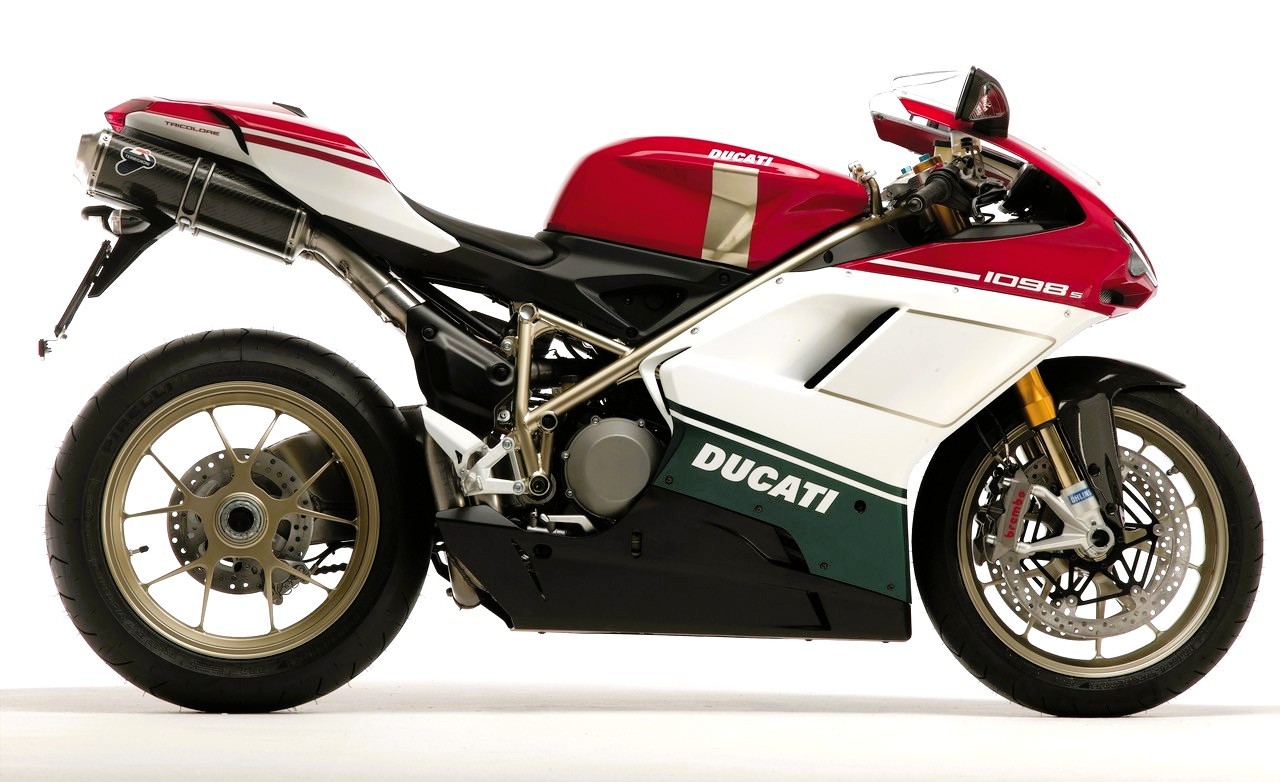
The dry weight of 174kg was now measured in Japanese fashion, without battery, oil and tyres, but the 1098 was still impressively light. A limited edition 1098S Tricolore was also available. Characterised by the colours of the Italian flag and a gold frame, this featured a racing exhaust and engine management system.

Although the 1098 was ineligible for Superbike racing in 2007, its excellence was clearly demonstrated in the FIM Superstock World Cup. In a close fought series, 18-year old Niccolò Canepa won the final round at Magni-Cours to take the title.
The 1098 evolved into the F08 factory World Superbike racer for 2008 and as the factory Xerox bikes that predominated. Bayliss immediately stamped his authority with five race wins in the first four rounds. After a mid-season slump, he came back to win a further six races, easily winning his third World Superbike Championship before hanging up his leathers.
Bayliss retired as one of Ducati’s most successful riders, his career spanning from 2000 when he was first drafted to replace the injured Carl Fogarty.
By Ian Falloon

Ian Falloon is one of the world’s foremost motorcycle historians and valuers, with a particular passion for Ducati. He has written many books on the marque, including Ducati 750 GT, The Ultimate Guide to Authenticity, Ducati 750 Sport, The Ultimate Guide to Authenticity, and The Complete Book of Ducati Motorcycles, Every Model Since 1946. The new, updated Third Edition, pictured above, is due for publication shortly. You can see Ian’s extensive range of titles, and get in touch with him if you would like to purchase, here.

Ba-ba-ba … ba-ba … ba-ba … ba-ba-ba … BA-BA-BLAAAAAAAAAM!!!!!!! As I accelerate through the long left-hand turn at Jerez, the sound from the 1098R’s free-breathing Termignoni cans is a curious misfire for several seconds, followed by glorious V-twin thunder as the Ducati finally chimes in fully, and rockets out on to the next short straight at a mind-boggling rate.
On any other bike I’d have been convinced there was some sort of problem that was temporarily cutting sparks or fuel in mid-corner. But not on the 1098R. This hesitation was the Ducati’s ground-breaking traction control system, activating in mid-turn to moderate the engine’s torque, then allowing the bike to rip forward with the full force of its stunning, 139kW V-twin powerplant.
Its pioneering use of traction control is the most eye-catching feature of the 1098R, but there is so much more to this, the most advanced and powerful production twin yet seen. It’s also the world’s most expensive twin, albeit still considerably cheaper than Ducati’s own Desmosedici RR V4. More significantly, the 1098R is the closest production bike yet to a genuine factory Superbike racer.

Much of the reason for that is the new SBK regulations, which impose strict new limits on how twins, especially, can be modified. The new rules inspired Ducati to design the 1098R accordingly, raising its capacity to the new 1200cc limit and fitting exotic engine internals where these must be retained for racing. They also added the DTC (Ducati Traction Control) system, which even the D16RR MotoGP replica doesn’t have, and which is described as an aid to racetrack performance, not a safety device.
Essentially, of course, this bike is a tuned and lightened version of the existing V-twin sportster, created as the basis for racing with little regard to cost or roadgoing niceties. Features including an increased compression ratio, titanium valves and rods and sandcast crankcases combine to reduce weight while increasing maximum output to a claimed 134kW at 9750rpm, almost 15kW up on the standard 1098. That figure increases by 5kW when using the supplied race kit, comprising Termignoni slip-on cans plus an ECU that enables the traction control.
The chassis retains the standard 1098 frame and geometry, but is upgraded with numerous carbon-fibre bodywork sections, plus forged instead of cast Marchesini wheels and Ohlins’ latest, ultra-sophisticated TTXR twin-tube rear shock. Its familiar 1098 steel trellis frame is fitted with a rear subframe made from aluminium instead of steel, which helps reduce dry weight to 165kg, 6kg down on the 1098S.
The riding position and Moto GP-style digital instrument panel are retained, so the Ducati felt familiar as I threw a leg over the thinly-padded single seat and blipped the throttle, the eightvalve desmo motor’s titanium internals letting it spin up deliciously quickly.
Never mind fastest twin ever; with the exception of the Desmosedici RR this is surely the fastest and most focused streetbike ever built. I hadn’t ridden at the southern Spanish GP circuit for several years, so it was no surprise that during my first session the R-bike made the vaguely-remembered track seem as though its already short straights had been halved in length, so rapidly and relentlessly did the bends flash up ahead of me.

Mind you, the bike as well as the circuit took some getting used to. I was surprised to find that, initially, its standard suspension settings were too soft (at least for my 85kg), so the front end dived under braking and the rear tended to squat under acceleration, making the Ducati run wide. The motor also revved so rapidly that I initially found myself hitting the 10,500rpm limiter before I had time to change up, until I realised that the big V-twin was so grunty that it was best to take most bends a gear higher than I’d first thought.
Ridden like that, it was not just staggeringly quick, but superbly enjoyable to ride, too, punching forward with a gloriously smooth, free-revving feel, as well as with that booming V-twin soundtrack. Out of the slower bends it was hard to keep the front wheel on the ground, even when I kept my weight as far forward as possible. Jerez is a compact track, and even on the back straight I was barely into fifth, still pulling mighty hard, but well short of the bike’s 300km/h-plus top speed. The gearbox generally shifted very sweetly, apart from one false neutral.
A more regular, if minor, transmission-related complaint was that second gear was too low for several of Jerez’s slower bends, and third slightly too tall. That’s because the third, fourth and top internal ratios have been made taller to allow for the extra power, while second is unchanged, leaving a bigger gap. The motor is flexible enough that this was no problem on the launch, but it would cost a few tenths in a race (except for Bayliss and Co, who’ll have a choice of ratios).
As for the much-publicised traction control… well, it definitely works, although my own experience was inconclusive. The DTC system has eight levels of sensitivity, selected via a button on the left clip-on. Thousands of times every second it senses parameters including front and rear wheel rotation, revs and throttle position, and temporarily cuts power by retarding the ignition when it deems this necessary. That’s generally when rear wheel speed exceeds front wheel speed, suggesting a slide. But the system is more complex than that, so it allows wheelies even if the front wheel slows while off the ground.

During my first couple of sessions, with the DTC set on its midway level four setting on the recommendation of Ducati MotoGP tester Vito Guareschi, I couldn’t detect the system working. That’s how it should be when you’re relearning a track and fine-tuning suspension, especially as we were using phenomenally grippy Pirelli Diablo Supercorsas — the rear an SC2 compound and the front an even softer SP 1, both stickier than the SP compound that the 1098R will be delivered with.
I was riding pretty hard, but not hard enough to get that mega-grippy 190-section SC2 sliding, so why would the traction control kick in? One option would have been simply to crack the throttle open in mid-turn and see what happened, but Ducati development chief Andrea Forni said this wouldn’t be a good idea, however good the DTC was…
For my final session l was determined to experience the system working, so Forni suggested trying level six, which would activate it earlier. By that time the Ducati and my riding were dialled-in, with the result that the DTC stuttered into action as l opened the throttle at the apex of most turns.
Whether it was helping me ride faster was another matter, as most of the time the rear Pirelli would still not have been sliding. But given more time to experiment, and the opportunity to use the more advanced DTC settings when I was lapping faster, I’m confident that the system would have come into its own, especially when the rear tyre wore and lost grip.
The fastest riders (including ex-MotoGP ace Jeremy McWilliams) were lapping extremely rapidly with the DTC set on levels one or two, and with it cutting in very rarely. The system clearly works at the highest level, which is no surprise as it’s essentially identical to that fitted to Casey Stoner’s Desmosedici — and as Forni said drily, the results of that bike are well known.
Alongside the novelty of experimenting with the traction control, it was satisfying to adjust the Ducati’s relatively conventional chassis, and to feel the bike being gradually honed into a typically taut and precise weapon. By the end of the day I’d added a turn of preload and a click of compression damping to the 43mm Ohlins forks, and 1.5 rings of preload, plus compression and rebound damping to the rear.
The firmer front end meant the 1098R dived much less even when those fiercely powerful Brembo Monobloc calipers were biting the 330mm discs so hard that l was struggling to prevent myself being flicked over the screen. At least I didn’t have to worry about what the back tyre was doing under braking, as the new slipper clutch worked flawlessly. And the extra rear ride height ensured that the Ducati’s original tendency to run wide in turns was gone, so the light and responsive bike now flicked in with much less effort, and held its line superbly.
Once set-up, the suspension soaked up track imperfections and gave huge feedback on just how those sticky Supercorsas were gripping. Even so the Duke gave an occasional shake of its head under hard acceleration, one time violently enough to prompt me to hurriedly add a couple of clicks of the transverse-mounted Ohlins steering damper as the bike devoured the back straight. Further tweaking would doubtless have got it more stable with no loss of agility, but sadly there was no time for that.

Riders with sufficient funds to buy a 1098R will be able to take more time to get it perfectly set up, of course, and will be glad to know that the R has the same 12,000km service intervals as the standard 1098, despite its extra performance. That’s remarkable, especially when you consider that this bike is only 6kW down on Troy Bayliss’s 999cc factory Superbike from last year and matches its 165kg weight figure.
Phew! A genuine mass-produced motorcycle that is as light and very nearly as fast as the exotic factory missile on which Bayliss won seven races last season. Despite that sky-high price tag, the $54,995 1098R suddenly looks like a bargain for those who can afford it – either as the basis for a seriously capable racebike, or as a magnificent roadster for track days and Sunday morning blasts.

Light Speed
The 1098R uses two-ring instead of three-ring pistons, with its crankshaft lightened and rebalanced to suit, but the only other engine differences are details such as sparkplugs and oil filter.
Larger capacity was a major contributor to the 1098R’s extra horsepower. The revamped Testastretta Evoluzione desmo powerplant gains its 1198cc capacity from an increase of roughly 2mm to both bore and stroke over the 1098cc unit, giving dimensions of 106 x 67.9mm. Alongside the peak power output of 134kW at 9750rpm, it also produces a maximum of 134Nm of torque at 7750, 12Nm up.
Much effort went into making the engine lighter as well as more powerful. Standard conrods must be retained for Superbike racing, so the 1098R gets Pankl titanium rods that are 29 per cent (130g) lighter than the stock steel ones. The crankshaft is 22 per cent lighter, while the chrome nitride-coated titanium valves are also considerably lighter despite being roughly 2mm wider. This allows the desmo motor’s cams to have increased lift. The pistons’ double-ribbed undercrown is based on Desmosedici racing design, and helps allow an increased 12.8:1 compression ratio.
The crankcases and cylinder heads are produced by sand casting instead of the normal die-casting, which improves the molecular quality of the casting allowing reduced weight and increased strength. Magnesium cam covers and carbon-fibre cambelt covers also contribute to a weight saving of 2.2kg over the standard 1098 unit, and no less than 5.6kg compared to the 999R engine.
A revised injection system features larger elliptical throttle bodies with diameters equivalent to 63.9mm, up from 60mm. The 1098R also becomes the first Ducati streetbike to use twin injectors per cylinder. The central, four-hole injector works all the time, supplemented by an offset, 12-hole injector that joins in when required at higher revs.
As well as having taller third, fourth and sixth ratios, the gearbox has its cogs machined from racing-grade steel, and the top four gears are shot-peened for extra strength. The dry, multi-plate slipper clutch is another addition.
Chassis spec is similar to that of the 1098S, with an unchanged steel trellis frame and a magnesium front subframe. The single seat rear subframe is aluminium, saving 1.3kg. The single-sided aluminium swing arm is unchanged except for being black.
Ohlins provides the adjustable transverse steering damper and 43mm inverted forks, which have titanium nitride-coated sliders. Brembo’s Monobloc four-piston radial front calipers and 330mm discs are retained from the standard 1098; the Marchesini wheels are forged instead of cast.
The Ohlins’ new-generation TTXR rear shock uses two damping tubes instead of the normal one to reduce cavitation (oil frothing), and also friction. There is totally separate adjustment of compression and rebound, and the shock can be re-shimmed for race fine-tuning without dismantling the body.
By Roland Brown, Two Wheels, April 2008

Nearly 20 years after its release, the 1098 is readily available in the Australian used bike market, in large part because it sold well when new. Those that weren’t raced or binned at track days seem to have survived as rarely-ridden garage queens with pretty low kilometres, if the current listings at bikesales.com.au are an indication. Prices start at around $10,000. Check them out here.