BMW R1100S 1998-2005
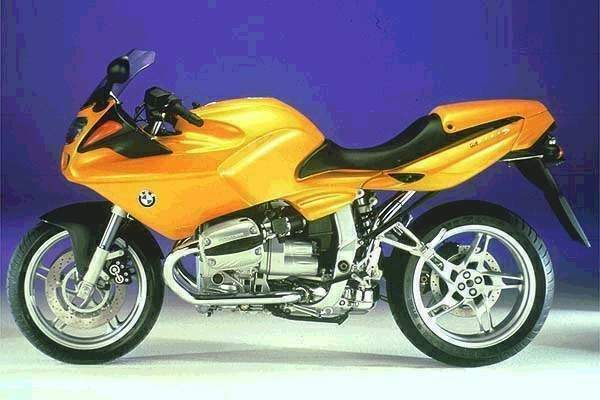
Something has stirred inside BMW’s Boxers. Something more potent than ever before. The RS, the GS and the rest were all foreplay. The foreplay was nice, but the S is the real action. Hard, fast and very capable. And with experience behind it.
Anything in Boxers is by nature conservative. Not flash or fancy like skimpy little Japanese or Italian performers. But Boxers promise a different pleasure — rhythm, staying power and the ability to go the distance without wavering. The R1100S does the Boxer thing with more agility and more power than any of the others. It’s a logical progression for the R-Series bikes, which have already branched out in every other direction.
We know what the new Boxers are good for: adequate power underlining an extremely stable, road-hugging chassis with Telelever front suspension.

Boxers are bikes that work well on all roads, that keep their cool on crappy surfaces, that are often sportier than they should be (particularly so for the RT) and are very comfortable. The S fits right in, and doesn’t even sacrifice the comfort — much. And it has a prowess all its own.
The S brings new features to the Boxer range along with its boosted performance. After all the fanfare BMW made of the modern Boxers’ lack of a traditional frame, the S re-introduces one in the form of welded aluminium spars to keep the chassis stiff. The engine/gearbox unit is still a stressed member, but the new frame unites front and rear suspension and the Paralever swingarm pivots from it, rather than from the gearbox housing.

The frame ties together a great bike for buzzing backroads at high speed in perfect control. Tauter suspension, sharper dimensions and lighter weight compared to the RS model underline the sporty intent of the S.
BMW claims 229kg wet, so the S is still no lightweight, but in the running with other sporty bikes. A kilo has gone from the RS’s Telelever, the wheels are lighter, there’s no heavy ABS nor the extra 2.5 kg in the heavier battery and alternator needed to run ABS or heated handgrips. And a few grams have been saved by using magnesium for the rocker covers — it says so on the side, in what is a rare flash of boasting from the Bavarians — and carbon fibre for the front mudguard.
The S sits on a wheelbase 5mm longer than the RS, but with steering pulled back to 25 degrees rake and 100mm trail. One of the first things you notice when you ride the S is how quickly it wants to flick into a corner. Its initial steering response is instant. The S responds just as well to tight bends as to long sweepers. It does prefer to be angled in steadily, but will tolerate being stuffed hard into a corner. This is where the Telelever shows its road bias: the lack of dive under brakes is great for maintaining suspension travel over bumps, but doesn’t have the lovely side effect of steepening your steering angle just when it really counts. Nor is there the same weight transfer down on the front wheel. But if you bank it in less violently the S swings low and holds a steady line all the way through.
Better suspension than on any other Boxer hugs the road at speed. The S is the most stable, controlled and capable openroad blaster in the range, and beats most bikes hands down. The plush feeling of the RS at speed has gone, replaced by a more contemporary tightness from firmer suspension rates that are often more comfortable as well. On the S you hit a bump at speed in a corner and then it’s gone; there’s no slight delay afterwards while the bike settles again, as with the RS.

A knob behind the steering head lets you adjust the front end’s rebound damping on the move. The back end has preload, which you can also adjust on the move, and rebound damping adjustment. Lower settings are fine for typical solo riding, and there’s lots of scope for firming it up for extra weight or harder riding demands.
Cornering clearance is fractionally better than on the RS, and is quite adequate for the road; the footpegs and stands scrape a bit but you have to be pushing hard to touch down anything serious. However, for riders who lean hard on their S, there’s a sports suspension kit giving more clearance.
When you open the taps the R1100S drives hard enough. The engine, despite claims to BMW’s twin-cylinder power crown, is no fireball. Its 72kW — just shy of 100hp — puts it in the league of the Ducati 900SS and Yamaha TRX850, but well short of the Honda VTR1000. It pulls solidly and has smooth power delivery from as low as 2000rpm almost to the 8000rpm redline. Power drops off just beforehand, and a rev limiter cuts in at 8400rpm. Just off idle it is weak enough to stall at the lights if you let the clutch home fractionally too quickly.
The extra power of the S comes primarily from the new exhaust, which includes a catalytic converter. The new pipes sound good, too, and flow more freely up to the sexy, Ducatiinspired rear end of the S. The intake system is also less restrictive, with a flat air filter replacing the round one of the RS. Stronger forged conrods cope with the new model’s higher rev limit, and new pistons increase compression from 10.7 to 11.3:1. All Boxers now use a modified crankcase to improve oil circulation, and oil capacity is slightly greater.

The sweetest power is in the upper midrange and top end. You can sing along all day above 4000rpm and always know there’s response and acceleration on tap. The increased power hasn’t hurt the excellent torque characteristics of the boxer, and the torque peak of 95Nm comes in at just 5750rpm. The dials show just under 3500rpm at 100km/h in top gear, and there’s acceptable overtaking acceleration from there.
Short shifting is often a better way to go on the Boxer, and power is so flexible that you can be in a gear higher than ideal and still have good performance. The twin’s engine braking is strong at high revs, and it’s often quicker — and certainly smoother — to blast along flowing roads in a higher gear that encourages you to keep up the momentum.
The engine prefers its prescribed diet of premium unleaded, and uses lots; six to eight litres burning every 100 km.
The S is a shaker, and the lack of rubber mounted handlebars means you always know it. Under about 3700rpm (100-110km/h in top) it pulses away happily, but as 4000rpm approaches (110-120km/h) the vibes set in stronger and stronger until by 6000rpm they’re all the way through the machine, tingling your hands, feet and bum. It is intrusive on transport sections, but when you’re concentrating on the road at speed the vibes are actually good communication from the engine as it works beneath you.


The gearbox is the same type as in BMW’s cruiser, but with an extra ratio. It works superbly except for the typical BMW habit of not easily selecting first from neutral. The usual single-plate clutch is good and not too heavy, but not quite as well-mannered as a multi-plate unit, being sometimes less forgiving of badly matched revs as you shift gears.
The R1100S has decent front brakes which don’t have the outright power you’ll find on many other sports bikes, but which still pack a punch and stop the 229kg machine without drama. Feedback is slightly reduced by the Telelever, which seems to make the brakes a bit remote compared to regular suspension systems, but you know you’re near the limit when the front rubber starts to squirm. The rear brake is very good, with power and feel beyond what you expect these days. S models fitted with ABS (anti-lock brakes) are due sometime in February or March next year. ABS will add weight and cost, but is still worthwhile for safety-conscious riders.
BMW lists four brands of tyre for the S. The Bridgestones fitted in this test suit it very well, complementing its steering and giving plenty of grip all the time, coping well in the wet.
The riding position is one of the best in the class. There’s no need for a soft sports bike to be uncomfortable, and the BMW gives you handlebars that are relatively high and only a slight stretch in front. The seat is well shaped, although a bit flat side-to-side, and firm. Your legs are not cramped and the footpegs, which are higher and further back than on the RS, allow a posture that gives the right balance between control and comfort.


The fairing and screen too are well designed, keeping the wind blast well away right up to 160km/h. You don’t have to crouch to reap its rewards, either. Some crosswinds will create uncomfortable buffeting, but that’s not typical.
Passengers also fare well, with OK legroom and a good seat. The standard solo seat cowl comes off to reveal grab handles and a small luggage rack with tie-down points. Under the seat is one of the few toolkits worthy of the name in motorcycling, in a neat tool holder, along with a puncture repair kit.

The ellipsoid headlight, borrowing from car light technology, has a strong and well-defined low beam and a high beam with adequate spread and penetration into the night. The headlight adds to the odd look of the BMW’s front end. The kidney-shaped air holes (the oil cooler is right behind) hint at BMW’s signature twin kidney grille car front end.
Mirrors are generally clear of bad vibration except at idle. BMW reckons the arms of the mirrors even provide a bit of high-speed down-force. The horn is okay, and the dash is very easy to read at a glance, although the fuel warning light is a pale green, not bright enough to stand out clearly when the sun is behind you. The centrestand is extremely easy to use, and the side stand only kills the engine when the bike is in gear. Quality and finish are good, but the ugly galvanised fairing bracket is an unfinished eyesore.


BMW wants to find new, younger customers with the R1100S. Its slow model turnover and typical four-to-five year ownership period for the bikes means BMW has to keep bringing in new customers to maintain sales, and so the S fills an untapped niche market that is growing. BMW sees the S pitching against the Triumph T955, Honda VTR1000F and Ducati 900SS; you could also throw in the VFR800 and Ducati ST2.
The BMW is perhaps still a bit conservative for younger buyers of VTRs, Daytonas and Supersports to see the similarities, but the Boxer hits the spot in its own unique way. Its overall performance is on par, and at $18,500 it is good value. In this soft-sports sector the last degree of performance is not critical, and the BMW adds more comfort and civility than the others.
The R 1100 S could do with less vibration, but there is little else to complain about. BMW has built itself an excellent sporty motorcycle with all the character and individuality of the boxer engine. It is everything you would expect of an open-road sports bike from BMW.
By Mick Matheson. Two Wheels, December 1998

Department S
The induction roar as the atmosphere gets hauled through the airbox of a big sports BMW twin can get the adrenalin pumping. But in 75 years of motorcycle manufacture, BMW has only bestowed the S badge on six models — the 1998 R1100S the most recent. It’s also the 100th model produced by BMW (without including the minor annual updates and special paint jobs) so it’s quite fitting that it should be a machine that joins a relatively exclusive club.
The first S appeared in 1960. The diminutive R50S is a rare 160km/h, 500cc twin which developed 26kW. It doesn’t sound much now, but it was quite a machine in its day. The overhead pushrod twin had a redline of 7650rpm — very spritely. Only 1634 were made and quite a few exist in Australia.
At almost the same time, the R69S hit the streets and this is considered by many as BMW’s classic sports machine. The additional capacity upped power to 31.3kW and top speed to 175km/h. Raced at endurance and club levels, the R69S was also favoured by the police force. Its speed was quite respectable for its time and easily enough to embarrass most British twins, especially if the contest was over a distance. Dubbed the “Whispering Death”, it gained a significant reputation in the hands of police patrolmen. From 1960-1969, 11,317 were produced.

The R50S and R69S sported steering dampers, Earles fork suspension, steel guards, hand-applied pinstriping and lovely enamel badges. They were also perhaps the last of the “Rolls Royce” quality machines.
The engines had a camshaft driven by gears from a pressed up crankshaft. They were assembled by engineers to exacting tolerances, a manufacturing method which could not stand the tough economic times of the 1970s. The following /5 model, introduced late in 1969, had chain-driven cams and a one- piece crankshaft which had proven both less expensive to produce and very reliable.
It wasn’t until 1973 that the next S appeared. BMW surprised the motorcycle world with a bikini-faired, two-tone smoked paint job, clothing a genuine sports machine, the R90S. With 50kW at 7000rpm and a top speed of 200km/h it was (and still is) a very rapid point to point machine. It became the basis for the famous Butler & Smith team which took the AMA Superbikes titles in the USA and the Daytona 200-miler during the late ’70s. The machine was also the basis for Helmet Dahne’ s Isle of Man classwinning entry. The top speed of the R90S was not exceeded by another Boxer twin until 1993, some 22 years later.
In 1976 it was replaced by the R100S, an extremely popular model. 11,762 units were produced in just three years. The additional torque of the bored motor produced a machine which finally won the Castrol 6-Hour crown, in 1977. In a race-long duel with the Kawasaki ZlB the BMW’s fuel efficiency and the consistent lap times of Joe Eastmure and Ken Blake won the day.

It wasn’t until 1985 that the only Sdesignated K-model appeared, the diminutive K75S. To many this was the sweetest handling of the Ks until the K1200RS was released last year. The 75S triple produced just 56kW and had a top speed of 210km/h. In many ways it was nothing really special, simply an excellent all-round motorcycle.
Of the S models so far, there are probably two really collectable models: the R69S and the R90S. Although rare, the R50S occasionally appears on the market. It seems that the R100S was rallied, ridden, crashed and resurrected but the model has not yet gained collectable status.
Obviously it is too early to tell whether the 1998 R1100S reaches collectable status. However, given the emerging reputation of the R1100GS and other new Boxers as being very competitive point to point on bumpy winding roads, the R1100S just may cut the mustard. It’s not light or overly powerful, but the overall package may be good enough to elevate it into the exclusive club of A grade models to have earned the S designation over 75 years of BMW motorcycle production.
By Geoff Hall, Two Wheels, December 1998

Boxing Clever
Racing and race replica bikes breed excitement and appeal to youth, so BMW must have suffered corporate cringe when Andy Hoffman won this year’s BMW Motorrad Boxer Cup. At 48, he’s not exactly in the demographic BMW is chasing with the R1100S. Then again, maybe it proves no one’s ever too old for fun.
The Boxer Cup racing series has been a huge hit for BMWs marketing people, thanks to close racing, plenty of celebrity appearances (Randy Mamola’s signature is just one bit of evidence) and an active push to get widespread coverage by scheduling races alongside other drawcard events such as MotoGP and America’s famous Daytona season opener.
And now Munich is chasing more glory with the Boxer Cup replica, an uprated R1100S painted and stickered like the real thing. It’s the first we’ve seen BMW’s blue and white race colours on a factory motorcycle in…err…ever. It comes fitted with the sports suspension pack with longer struts to improve clearance and a wider 5.5 inch rear rim and 180 section tyre. Rubber is Metzeler’s tacky Sportec M-1.

The graphics on the bike are just like what Randy Mamola had when he raced in the Boxer Cup, and the belly pan and carbon fibre protectors over the rocker covers are pukka, too. Add clear indicator lenses and you’re away for $20,700, or $22,450 with ABS.
Only about 50 have come Down Under. Other S owners get jealous as hell when they see you and other riders seem surprised at the racy image of the funny bike with sticky outy cylinders. And despite the sub 75 kW engine and over 200 kg bulk, there’s times when the Boxer gives all comers a run for their money. The telelever front end adds a level of control and confidence absent on other machines when you’re cranking into downhill bends, on the brakes, coping with bumps and generally pushing the pace on public roads.
The R1100S is stable and predictable and the power delivery is linear with no shocks or holes. But cross the line and try to ride this bike like a race replica instead of a BMW — in other words, forget that it needs to be written smoothly, deliberately and sympathetically — and its dynamics work against it. The two impediments are its rear end and the throttle response.

The Paralever driveshaft design is heavy, giving the poorly- calibrated shock a hard time on sharp bumps. Combine servo assisted braking power and ABS and it can stuff you up going into a corner when all factors come together to get the wheel hopping over bumps and the brakes coming on and off. Much better to ignore the rear brake totally. At full lean, with no throttle, the rear will slide out too easily on anything but a smooth surface. The throttle’s sharp on/off response isn’t conducive to finesse at the apex, either.
The strong power of servo breaking can be a great thing. That’s the good bit. The rest sucks. The irritating whine is bad enough without the potentially dangerous lack of power when the ignition is off, and sometimes even after the ignition (even the engine) is on. After several BMW tests, I’m slowly getting used to all this, but I still regard servo braking on a motorcycle as unnecessary, a technological wank for wanking’s sake.
I’m glad I had the ABS as a backup when I took the Boxer Cup to the track, because the savageness of the servos locked the front brakes several times going into corners.

Engine vibration kicks in from just under 4000 rpm and gets worse all the way to redline — pretty much covering the entire useful rev range.
I’m getting bored with complaining about the Boxer Cup, but I’ve got to mention the stone chips. The blue paint, especially on the belly pan, won’t last long and if history teaches us anything it’s that BMW will deny there’s a problem. The $800- plus carbon fibre mudguard’s gelcoat also flakes away under attack from road debris.
I’ve just about run out of room to explain why R1100S fans love them so much. If you can cope with overbearing braking technology, annoying design and many minor irritants, you’re rewarded with a sporty bike that doesn’t demand the commitment and fear of an R1, will last well beyond 100,000 km and has some class and style. A smooth rider can hunt along any road at up to eight-tenths pace and have a ball – fast, unstressed and doing that two-wheeled waltz that has you grinning all day.
At Brno, where the Boxer Cup series supported the Czech MotoGP round in August, the Boxers were little more than ten percent off Rossi’s pace on his Honda RC211V. You won’t get within cooee of that on the replica, but there’s satisfaction in knowing that, deep down, the potential is there in your unusual, individualistic sports bike.
By Mick Matheson, Two Wheels, November 2003.