2006 Kawasaki ZX-14
What the hell does Kawasaki think it’s playing at? I mean it’s one thing to build a motorcycle that lays claim to being one of the fastest things on the road, which pumps out 147kW at the crank with Ram-Air in full effect, and which makes 200km/h-plus feel like a walk in the park. You expect all that from the Big K, the company that’s made its reputation by bolting together some of the most hairy-chested in-line fours in all of motorcycling.
What I didn’t expect though, and what completely dissolved all my preconceived notions — despite the quiet warning I got from Murray Sayle when I collected the ZX-14 from Kawasaki Australia’s Sydney HQ — was just how bloody docile, well-mannered and … well… sensible Kawasaki’s newest hyper-bike flagship actually is.
ln fact, the ZX-14 is so damn nice it’s scary. Scary, because the bike not only lives up to all the high-performance hype that’s surrounded its arrival, but it has a confidence and poise and flexibility about it that might just make you wonder whether you’ll need another bike ever again.
Put simply, the ZX-14 is about as close to the perfect sports-touring motorcycle as it gets. And if you think that’s going over the top, then I suggest you get yourself down to a Kawasaki dealer and take one for a ride, because I guarantee this thing will blow your mind — not just with its speed and performance prowess, but also with its exemplary user-friendliness.

It all starts with the engine. As any engineer will tell you, it ain’t all that hard to build a motor to deliver big horsepower numbers. The real secret is distributing that power evenly, making it rideable from low down in the rev range to way up top. Such flexibility is especially important in a sports-tourer, which is going to be ridden in all kinds of weather and conditions.
Kawasaki’s answer was to develop an all-new engine for the ZX-14, building on the solid foundations established by the ZX-12R but extending the user-friendliness even further. Displacing 1352cc, the ZX- l 4’s inline-four makes all the right sorts of numbers. We saw rear-wheel peaks of 128.32kW at 9500rpm and 142.71Nm at 7700rpm on Sydney Dyna’s Dynojet. However, it’s the shape of the curves and it’s the way all those kilowatts and Newton-metres are delivered when you twist the throttle that’s so impressive.
From low revs the ZX-14 feels surprisingly tame in its power delivery. Like an iron fist concealed by a padded velvet glove, the Kawasaki’s engine comes on so smoothly and easily off idle that you’re almost tempted to think it is slow. Notice how l said “almost tempted”. That’s because there’s enough beef and enough substance behind the initial power flow that you really can’t mistake the ZX-14 for anything but a big-bore four. As the revs build, so too does the power, in a completely seamless fashion, and before you know it, 6000rpm is showing and the velvet glove has been cast off, leaving the sheer force of that iron fist fully revealed.

What it all means is that the ZX-14 is a blisteringly fast motorcycle that just happens to be an absolute doddle to ride slowly, which makes it perfectly confidence-inspiring in wet and slippery conditions, and an absolute delight in the cut-and-thrust of urban commuting.
It will accelerate smoothly away from as low as 2000rpm in top gear, and then keep on accelerating relentlessly but incredibly controllably until you decide it’s time to stop.
Much of the engine’s flexibility is down to the Mikuni fuel-injection system, which uses 44mm throttle bodies — 2mm smaller than the items on the ZX-12R — to produce a broader spread of power. Intake and exhaust valves of 33.4mm and 28.3mm respectively help as well, by speeding up the flow of gas into and out of the cylinders for instant throttle response. It’s a very quiet engine too, with minimal vibration thanks to the inclusion of a secondary balancer shaft and an oil-pressure cam tensioner.
Six gears are provided in the ‘box, with a new, linkage-less gear lever for a more direct feel in the changes. Not that you’ll be rowing the gearbox much, as the abundance of grunt gives the motor a sweet spot that’s a mile wide. Overall, the shift action is very good, although the ‘box does emit a noticeable clunk when first gear is selected.
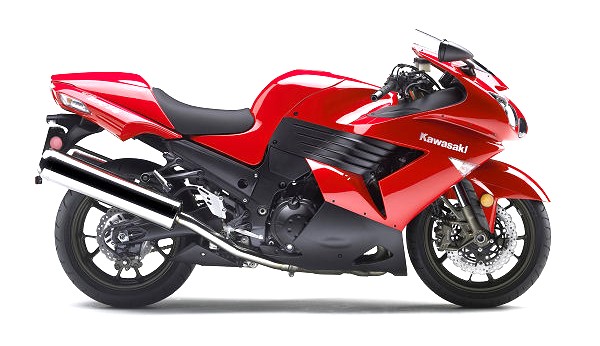
Another big surprise is how narrow and light the ZX-14 feels when you first climb on board. It looks very long, due to the way the bike’s lines have been penned — the swooping bodywork has the nose of the bike hanging well over the front wheel, and the seat and rear cowl tapers a fair way back as well.

The riding position could best be described as ‘mid-crouch’. The ‘bars are high enough and close enough to the rider to give an excellent feeling of control without placing too much weight on the wrists or forcing the back into an uncomfortable bend. It’s tied in with a plush seat that’s low enough at 800mm not to make the bike feel unmanageable for shorter pilots and which gives plenty of room to move on longer rides, plus sensibly-placed footpegs, all of which add up to long-haul comfort.
There’s good weather protection available from that swoopy fairing as well, although I would have liked the screen to be a little bit higher to push the flow of air just above my helmet. And the large slots in the fairing sides deliver a stream of warm air from the engine straight on to the legs that was especially welcome on cold winter morning rides, but could be a little too much come the summer months.
A new, easy-to-read instrument panel graces the cockpit of the ZX-14, comprising separate white-faced analogue speedo and tacho units, and a large, central LCD screen with a stack of useful features including a gear position indicator, odometer, fuel gauge, dual trip meters, current and average fuel consumption, fuel range and battery voltage.
There’s also a programmable shift and clutch engagement light — for the clutch, it can be programmed to light at any point between 3000 and 6000rpm to indicate the optimum time to engage the clutch for drag racing purposes, while the shift light can be set to show when to change up to the next gear.

Kawasaki has retained the ZX-12R’s innovative monocoque chassis, but refined it for the 14 so it is now significantly more rigid, yet lighter. The airbox and battery are located in the frame, while the 22-litre fuel cell is situated towards the back of the monocoque’s hump and extends under the seat to aid in mass centralisation.
All up, the ZX-14 weighs in at a claimed 215kg dry, the same as Suzuki’s Hayabusa and some 8kg less than Honda’s Blackbird. Having ridden all three, l reckon the Kawasaki is definitely more comfortable than the Suzuki and on a par with the Honda, however it’s in the handling where the 14 really shines.
The combination of 43mm inverted forks and a single rear shock with a new Uni-Trak linkage on the ZX delivers a ride quality that is bloody fantastic in the easy way that it deals with a wide range of road conditions. Neither too soft nor too stiff, the ZX’s fully-adjustable suspension seems to be able to cope with just about anything that’s thrown at it, from potholed and road-plated city streets to narrow and bumpy country backroads.
Apart from adding just a couple of clicks of extra rebound and compression damping at both ends, I had no need to make any further changes to the set-up as it handled everything we rode over with compliance and composure. The front end, in particular, was super impressive and reminded JB and me of the incredibly planted feel offered by the old ZX-7R.
The steering was similarly efficient, which wasn’t all that surprising given that the ZX-14 has a wheelbase of 1460mm — quite a bit shorter than both the ‘Busa and the Blackbird. The bike has quite a lively feel on turn-in, which makes it great fun to ride in the twisty stuff, but it’s tempered with exceptional stability.
The ZX-14’s radially-mounted, four-piston Nissin front calipers and petal discs are taken directly from the ’06 ZX-10R, and work brilliantly, offering stopping power galore with a beautifully direct and precise feel at the span-adjustable lever. It’s also pleasing to see that the rear brake — a two-piston caliper and 250mm petal disc combo — has sufficient power to be very useful as an adjunct to the front stoppers without ever feeling too strong.
As befits the flagship of the Kawasaki range, the build quality and standard of finish on the ZX-14 is very high. There was one small issue with slightly inconsistent panel fit on the plastic cowling at the front of the fuel tank, but overall it’s been screwed together well.
With the pillion seat cowl fitted, luggage-carrying ability is limited on the ZX-14, but the cowl is easily removed via four bolts in the underside of the seat, exposing a generous pillion perch. There are two strap hooks poking out from beneath the rear sidecovers for securing gear, and the pillion peg hangers can also be used as attachment points. Underseat storage is non-existent, although the toolkit is quite comprehensive and comes in a sturdy little box. In standard trim, the ZX-14 only has a sidestand, however a centrestand kit will be available as an option.
There’s a hell of a lot to like about the ZX-14, and not much at all to criticise. Kawasaki has taken the hyper-sports-tourer concept to a new level of sophistication in terms of performance and flexibility, handling and comfort. The ZX-14 has been a while coming, but I reckon the wait was well worth it.
There’s a new king in town, and it looks likely to rule the roads for quite some time.
By Pete Callaghan, Two Wheels, August 2006